Wednesday, September 25, 2013

Event Preview: Three Questions With Brian Friedman ('95)


On Friday, September 27, the Cornell Sports Business Society is pleased to be hosting Brian Friedman ('95).  Friedman is currently in his fourth year as the Chief Financial Officer for the New York Jets.

Friedman is responsible for all financial planning and daily accounting operations for the team, financial oversight of the team's interest in MetLife Stadium and all internal and external reporting to the NFL and various other agencies. Additionally, he oversees information technology and practice facility operations.

Prior to joining the Jets, Friedman was the chief financial officer of Blissworld, LLC, the owner and operation of Bliss spas and seller of a full line of retail skin care products. At Bliss, he was responsible for all financial operations.

Before joining Bliss, he was the senior director of finance for the Columbia House Company and prior to that held several finance roles of increasing responsibility at Polo Ralph Lauren. Friedman began his career at Price Waterhouse and is a certified public accountant.

Friedman graduated from CALS, majoring in AEM, and has an MBA from Columbia University.


 In preparation for our event with Brian, we conducted a 3Q interview that would help preview the content that will be covered on Tuesday.


(1) What do you find to be the most fulfilling part of your job in your fourth season as the Jets' Chief Financial Officer?

In a word – Sunday. The most fulfilling part of my job is being part of an organization that millions of people are so passionate about. Seeing all the work show up on Sunday’s is a great feeling. Whether it is fan experience at the game or advertisements during the post-game show, being in a role that touches every part of the business, when that business is football, is just fantastic.

(2) What is it like to be involved with the planning of the first ever cold weather Super Bowl?

It is a tremendous experience to see how an event of this magnitude takes shape. The number of people involved with planning and executing a Super Bowl is unbelievable. The necessity to imagine every unimaginable scenario and plan for it is something to witness. When indoors your biggest issue is to make sure the lights stay on, with our stadium the list of potential issues is endless.  

(3) Friday will be your first-ever event with the Cornell Sports Business Society. What are some of your objectives in engaging Cornell students who may be interested in careers in sports and/or finance?

My goal is simple – to try and leverage my experience to help current students achieve their career goals. I am very fortunate that I get to work in a job that I have a passion for in an industry that I have always been interested in. My experiences at Cornell had a huge impact on my life and gave me a foundation to achieve many things throughout my career.

BONUS:  What do you miss most about your days at Cornell?

I miss the freedom, the camaraderie, spending every day with lifelong friends who are now spread all across the country. During my summer job before my senior year, my boss told me to enjoy Cornell because life is like one giant final exam. Truer words were never said – enjoy the time here.

Brian will be speaking to the Cornell Sports Business Society in person on Friday, September 27th. Please join us in Ives 105 at 4:30. For more information, check out the event on Facebook.

 We hope you can make it!

Labels: , , , , , , , , ,

Wednesday, October 10, 2012

Event Recap: Gary Gertzog '80

Gertzog '80 with members of the ILRSBS E-Board
On Friday, September 28th, the Cornell ILR Sports Business Society was joined by Gary Gertzog '80, the Senior Vice President of Business Affairs and General Counsel of the NFL.

During this Q&A session, Gertzog discussed NFL topics such as globalization, the emergence of the Red Zone Channel, the rise of fantasy football, as well as his career path and career advice for students.

On his career path, upon graduating from Cornell:

Gertzog graduated from Cornell's School of Industrial and Labor Relations in 1980. He knew that he wanted to attend law school, and ultimately decided to pursue this path at George Washington University. It was a strong school, and it was in a big city - the latter of which he didn't get to experience in Ithaca.

Upon graduating from law school, Gertzog was hired by a New York City-based law firm, Townley & Uptike, in 1983. Upon becoming a partner at the firm, Gertzog's first case was a highly publicized vessel collision in New York Harbor. When someone resigned from NFL Properties, he was asked to handle trademark and licensing work for the NFL.

He admitted that, although he was ecstatic about the thought of this opportunity, he tried not to let it show.
"I told them, you know, I got this New York Harbor vessel case I'm working on right now, so I'd have to see if...actually, yeah, I might be able to fit this in."
Gertzog first started by sending cease and desist letters to anyone using the NFL logo. One example he specifically brought up was a group who started selling "New Jersey Giants" gear as a joke on the Giants, who play their home games at the Meadowlands in New Jersey.

When an executive whom he was closely connected with at the NFL was promoted, Gertzog was asked to replace him in the position as the head of NFL Properties in 1994.

On his role with the NFL:

Since joining the NFL, Gertzog's role at has expanded to include the overall legal and business affairs  for the NFL’s commercial operation. The NFL, as he likes to describe it, is:
"Made up of two parts - the first component is the football side which serves as the unincorporated association for the 32 teams. The other part is the business side, which I'm involved with, and that is everything that makes money for the National Football League."
Gertzog said his involvement with the NFL's business includes everything from TV contracts (the NFL Network and the Red Zone Channel), corporate sponsorships, and licensing, to hundreds of companies, league and team marketing, intellectual property, providing business advice, and other media ventures in the form of radio, internet, and wireless devices.

On the biggest challenges and accomplishments over the course of his career with the NFL:

Gertzog said,
"I've been at the NFL for over eighteen years, and have stayed because of the constant challenges there are. Every day is different, every hour is different, and every challenge is different."
Gertzog's first case as an NFL executive was a landmark suit between Cowboys' owner Jerry Jones and the NFL. The business model at the time had the NFL selling and overseeing the marketing rights for all 32 teams. Jones, along with Al Davis, and the other NFL owners, were paying hundred of millions to own teams, and they wanted to control the marketing rights.

While this was one of Gertzog's biggest challenges, it also became a major accomplishment. As a result of this case, the NFL created a new business model where portions of marketing rights were reallocated to the teams, with the NFL still overseeing the majority of them. This model has led to success, and in 2004, it was extended for 15 years. In fact, it has since been extended for another seven years, which has brought long term stability to this former issue.

On some of the NFL's most important business initiatives during the past year:

To resolve last year's lockout, the NFL and the NFL Players' Association agreed on a ten year labor deal with no early termination rights. This labor deal is longer than any deal that has been put into by any of the four major sports.

This was tremendous for many reasons; but most importantly, it provided security and was essential in negotiating new league partnerships because neither side had to worry about a work stoppage in the next ten years. This set a foundation for the NFL's TV deals. The NFL made an eight year agreement with ESPN for Monday Night Football, in addition to a nine year deal between CBS, Fox, and NBC which rotated the broadcasting rights for the Super Bowl  every three years. Both of these deals are the longest deals of their kind.

The NFL also made a ten year agreement with Pepsi. Gertzog said long term deals are essential - the first year or two are mostly used to figure things out, and once they've find the right formula, they start to see a substantial return on their investment over the long run.

Another important development has been the emergence of the NFL-operated channels, the NFL Network and the Red Zone Channel. This year, the NFL Network finally came to an agreement with Cablevision and Time Warner Cable after years of not being featured on these cable providers. The NFL Network used to televise the NFL's eight Thursday Night games. However, this year, the NFL expanded to 15 Thursday Night games, and they felt that was a key bargaining chip. The NFL Network now has a reach of over 70 million homes, and the NFL feels that they have completed their distribution.

Gary Gertzog ' 80


Asked if the at-home experience was surpassing the in-stadium experience:

While the NFL has taken many steps to improve the quality and accessibility of the at-home experience, it might be at the expense of selling season tickets. With the secondary ticket market available to consumers, season tickets are becoming devalued to fans who can who can pick and choose which games they'd like to attend, instead. Becausee most of the NFL's revenue is generated from media rights, it wouldn't be as strong if seats weren't being sold.
"We need to convince people that there is nothing like the in-stadium experience. That nothing compares to showing up early to tailgate in the parking lot, or being at the game when the home defense has to make a stand on 3rd & 1 - and you're on your feet screaming along with 80,000 other fans. There simply is nothing that compares to being at the game."
However, with the emergence of the secondary market, and the Red Zone Channel, and fantasy football, some people might simply prefer to stay home, because the lack of stadium Wi-Fi prevents them from being connected. The NFL is working with companies like Verizon and AT&T to get NFL stadiums Wi-Fi enabled - to keep fans connected with each other. Stadiums are also making an effort to show highlights and statistics from around the league during timeouts and breaks, something they rarely used to do.

Another key issue that might devalue the in-stadium experience that the NFL is working to improve is fan conduct. Fans pay a substantial amount of money to go to the stadium, and might be accompanied by their kids. If a fan's behavior is out of line to the point that it's detracting from others' experience, then that is unacceptable. If a fan's behavior takes away from your experience, it used to be that you'd have to find security and bring them down to your section to address that fan. However, the NFL has set up a texting service that allows fans to do this anonymously - where each stadium security has a number that fans can text with their section number, the issue, and a description of the fan, and security would take care of it without exposing you to that fan.

On the globalization of the NFL:

The NFL has taken many steps in the past decade to foster a globalization of their product. That started with NFL Europe, which wasn't the most successful initiative, but it allowed Europeans to become somewhat accustomed to the game. Five years ago, the NFL had its first regular season game in London, which sold out Wembley Stadium in minutes. Gertzog laughed as he recalled the progression of the English fans during this annual game:
"Five years ago, when the Dolphins played the Giants, I remember there was a touchdown scored, and you could almost hear a pin drop...I was so confused. Then all of a sudden, the kicking unit comes out for the extra point, and when the ball went through the uprights, the crowd went absolutely crazy. It was funny to see, but it just showed that the fans weren't fully familiar with the rules of football. Then three years later I went back, and they finally started going crazy for the touchdowns, which is a good sign!"
Gertzog claimed that the ultimate goal for the NFL is to eventually have a franchise based in Europe to capitalize on this expanding market.

Gertzog's advice for aspiring sports business professionals:
"A lot of students want to graduate and jump right into sports. At the NFL, we get about 2,000 resumes every year to fill 8-10 positions. I would strongly recommend that you try to get experience elsewhere, and master a craft that can be applied to sports. Get a job in law, media, marketing, or finance, and get the experience. If anything that strengthens your resume and your experience, as opposed to someone who jumps right into sports."
Gertzog also stressed how there are also so many ways to work in sports. He mentioned that not only can you work in the agency side that most people associate with sports business, but to also think about businesses that have influences in sports. Companies that have products in sports such as Nike, Under Armour, and EA Sports are a great avenue to work in the industry. Moreover, a brand with strong sports sponsorship ties, like Anheuser Busch or Visa, also gets you close to the industry, too.

Miscellaneous: 

- The NFL took somewhat of a leap of faith in hosting a Super Bowl at the new MetLife Stadium. The NFL, he said, is "crossing their fingers" hoping that it goes well. New York has great potential to host the Super Bowl, as long as the weather holds up. If all goes well, he said to expect a cold weather Super Bowl once every 3-4 years.

- The issue of concussions in football has led to less kids playing at a competitive level in their youth. However, the NFL has realized that a lot of these youth and high school leagues follow the NFL for guidance in making their game safer. The NFL has implemented many rules recently in order to make the game safer, and they see these youth leagues following their lead. The league is investing and donating heavily in order to gain a better understanding of head injuries and continue to do so.

- The NFL recently allowed teams to have ads on their practice jerseys. However, Gertzog doesn't see the NFL going in the direction of ads on their game uniforms. One reason is to maintain the purity. However, it also might serve as a conflict of interest for competing sponsors who already pay the NFL billions of dollars.

- Though the Pro Bowl has terrific TV ratings (higher than some NBA postseason games), the product itself has been somewhat disappointing, and the NFL is concerned about the competitiveness of the game. Gertzog feels that this might be due to the fact that the Super Bowl is the absolute peak of the NFL season, and that anything after that is due for a drop off in hype, excitement, and overall interest.

- With the recent news of the approval of Farmers Field in Los Angeles, Gertzog also said that the NFL has a goal to eventually bring a franchise to the nation's second largest media market. It would be too complicated and expensive, and would also ruin the logistics of having a sound number of teams (32) to introduce an expansion team. Thus, the NFL would be more open to moving a franchise to LA if it were ever needed or appropriate.

- Gertzog described fantasy football as one the "stickiest applications." In other words, fans who use one website for fantasy football, are more inclined to use that website for their future leagues. The NFL is still behind Yahoo! and ESPN Fantasy with 2.8 million subscribers at the moment. However, the NFL wants to continuously promote their competitive advantage which is the integration of NFL videos and highlights.
_ _

We are thankful that Mr. Gertzog took the time out of his schedule to speak with our group. We all gained a tremendous amount of insight on the business of the NFL, and are fortunate for that opportunity. We hope to stay connected with Gertzog moving forward, and would welcome him to speak with our group at any time in the near future!

Labels: , , , ,

Wednesday, October 3, 2012

Event Recap: Scott Malaga '89

The ILRSBS E-Board with Scott Malaga, 9/21/12

On Friday, September 21st, the ILR Sports Business Society hosted former Cornell Big Red football captain, Scott Malaga ’89, who now serves as the Senior Vice President of Strategic Partnerships at Intersport.

As SVP, Strategic Partnerships, Malaga oversees the sales efforts for the Sponsorship & Event Marketing division at Intersport, which is a sports, entertainment, and media marketing company based in Chicago.

Before joining Intersport, Malaga had over fifteen years of experience in sports marketing, and most recently served as the Chicago Fire’s SVP of Corporate Partnerships.

Club members were provided with a unique presentation from Malaga, in which he discussed career path, and outlined the field of sports marketing with specific case studies from his career.
“You could’ve invited someone who spent 25 years with the Yankees, or someone who spent their entire career at the NHL, and they’d focus mainly on that. Sports marketing is a very broad industry, a broad term, and a broad definition. I have had many stops along my career in numerous areas of the sports marketing spectrum, and those experiences are what you can learn from me.”
On his collegiate years:

Malaga graduated from Cornell in 1989 as a business management major and dual sport athlete. While playing centerfield on the baseball team, he was also the captain of the Big Red football team. Malaga was the starting running back for the team that won the 1988 Ivy League Championship and is a member of the Cornell Athletic Hall of Fame.

Near his Cornell graduation, Malaga attended an event at the Johnson Business School featuring an executive from the Baltimore Orioles. At the time, the sports industry wasn’t common to enter, so Malaga asked him how he could get his foot in the door. He was referred to Ohio University, where he earned his masters in Sports Management.

On his early years in sports marketing:

Malaga’s first job upon graduating from Ohio University was with a company that bought the licensing rights for Champion Footwear. His main responsibility was to travel to NFL and NBA teams, as well as universities to sign athletes and programs to shoe contracts. To do this, he had to have a strategy. Here, it was to develop relationships with each team’s equipment manager.
“I would fly to Kansas City, rent a car, drive to the Chiefs’ facilities, talk to their equipment manager, and ask about players that didn’t have contracts AND were visible. I’d meet with those players, and if I felt they would give us exposure, I’d sign them to a contract Then I’d drive my car back to the airport, go to Denver, rent a car, meet the Broncos’ equipment managers, do the same thing, fly to Los Angeles - this time rent a convertible - and do the same thing over again. My strategy was to develop relationships with these equipment managers who were accessible and knew what was going on within the team.”
After all of that traveling, and to move closer to his family, Malaga decided to quit his job and move to Chicago. Simply put, he said,
“Don’t quit a job, and this is especially true in sports, unless you have another job lined up. I found out the hard way, spending the next 8 months looking for work.” 
Malaga found a job with Kellogg’s working in their food service division, where he utilized sports to sell their products to distributors and institutions. For example, when Kellogg’s had a deal with a sports entity, he created an incentive-based program that provided X tickets to that entity, for every Y number of cases of cereal sold to their distributors and/or consumers.

On his return to Cornell and beyond:

Though his job at Kellogg’s was somewhat connected to sports, Malaga was looking for something more directly involved. At his five-year reunion at Cornell, he was asked to work in Athletic Public Affairs in a fundraising role for the Athletic Department. He created the Cornell Football Association, which is over 3,000 members strong, and eventually spawned the Ivy Football Association.

However, after 2 years, he wanted something else. So Malaga left the Cornell Athletic Department, and went to work in a revenue-driving role in sports. He had stops at Advantage International, Host Communications, Inc. , and ISP Sports where he mostly sold collegiate multimedia rights. At Host Communications and ISP Sports, Scott was involved in the beginning of the whole “multimedia rights bit in college sports.” He said,
“The trend started developing where companies would take the risk, buy the rights from these big schools, and then resell them. The universities loved it because they were guaranteed revenue.”
Both Host Communications and ISP were bought out by IMG College, which now has a stranglehold on the collegiate rights business.


On his work with the Chicago Fire, and the search for a new jersey partner:

In 2009, Malaga was offered to serve as the VP of Corporate Partnerships for the Chicago Fire. He admitted that he “didn’t know a thing about soccer.” But he always wanted to work on team-side marketing where he could influence ticket sales, marketing, community relations, and corporate sponsorships. He was also enticed by the fact that soccer was an international sport, and that the MLS was a growing brand.

In the beginning of his tenure, the Fire were informed that Best Buy would not be renewing their $2.7 million/year deal to be their official jersey partner. Malaga showed club members the marketing deck that was used to gauge interest from potential brands.
“To find a brand that was looking to spend $2.7 million for a jersey partner for the Chicago Fire, you had to find the perfect storm – we were looking at CMO’s of Chicago-based companies, CMO’s that were looking to utilize soccer, or in international markets, and/or interested in reaching the Hispanic market because 50% of our fanbase was Hispanic.” 
 “We then started talks with Quaker Oats. A guy on my staff who used to work at Coke for 20 years, and he had a friend that was now the VP of Supply Chain at Quaker Oats, who introduced us to their president. The Quaker Oats president is from Mexico, and when running the Quaker Oats brand in Mexico, he made one of their products (Gamesa) the jersey partner for a Mexican soccer club. This was an executive who loved soccer, and saw how much revenue soccer could bring the Quaker Oats brand. Quaker Oats was looking to eat into Kellogg’s market share in Chicago, and they emphasized the values of health, fitness, kids, and nutrition. All of a sudden, we had the perfect marriage.”
A deal was finally agreed upon, and Quaker Oats and the Fire began their collaboration for activations. First, the Fire created the Quaker Corner at the Toyota Park, which was a whole section branded by Quaker Oats, where products were constantly handed out. Another important initiative was the Fire’s integration of Quaker Oats into local Chicago youth soccer tournaments.
“We wanted to expand the reach of the Fire and Quaker Oats broader into the community. Every year, there are four major youth soccer tournaments in Chicago featuring over 450 teams. We not only could reach kids, but there are also parents that are stuck there for the day because each team played multiple games. So I met with all the leaders of the tournaments, and asked to sell into their tournaments in exchange for a small share of our revenue.”
The Fire directly integrated the Quaker Oats brand into this marketing by having signage at over 40 fields, and handing out product to kids and parents throughout the day.

 Read Joe Favorito’s latest blogpost regarding the Fire’s most recent initiative with Quaker Oats

Intersport Presentation: 

 Malaga left the Chicago Fire in 2011 to work in the sponsorship and events marketing division at Intersport, where he focuses on client relations. Upon getting his new position, he said, 
“My career hasn’t been specific in one field, and now, since Intersport offers so much, I can fall back on each experience and apply it in some small way – I know a little about a lot.” 
Malaga shared with us a marketing deck that Intersport sends brands to outline their services in sports marketing. Here is what he had to say about some of these services:

Consulting:

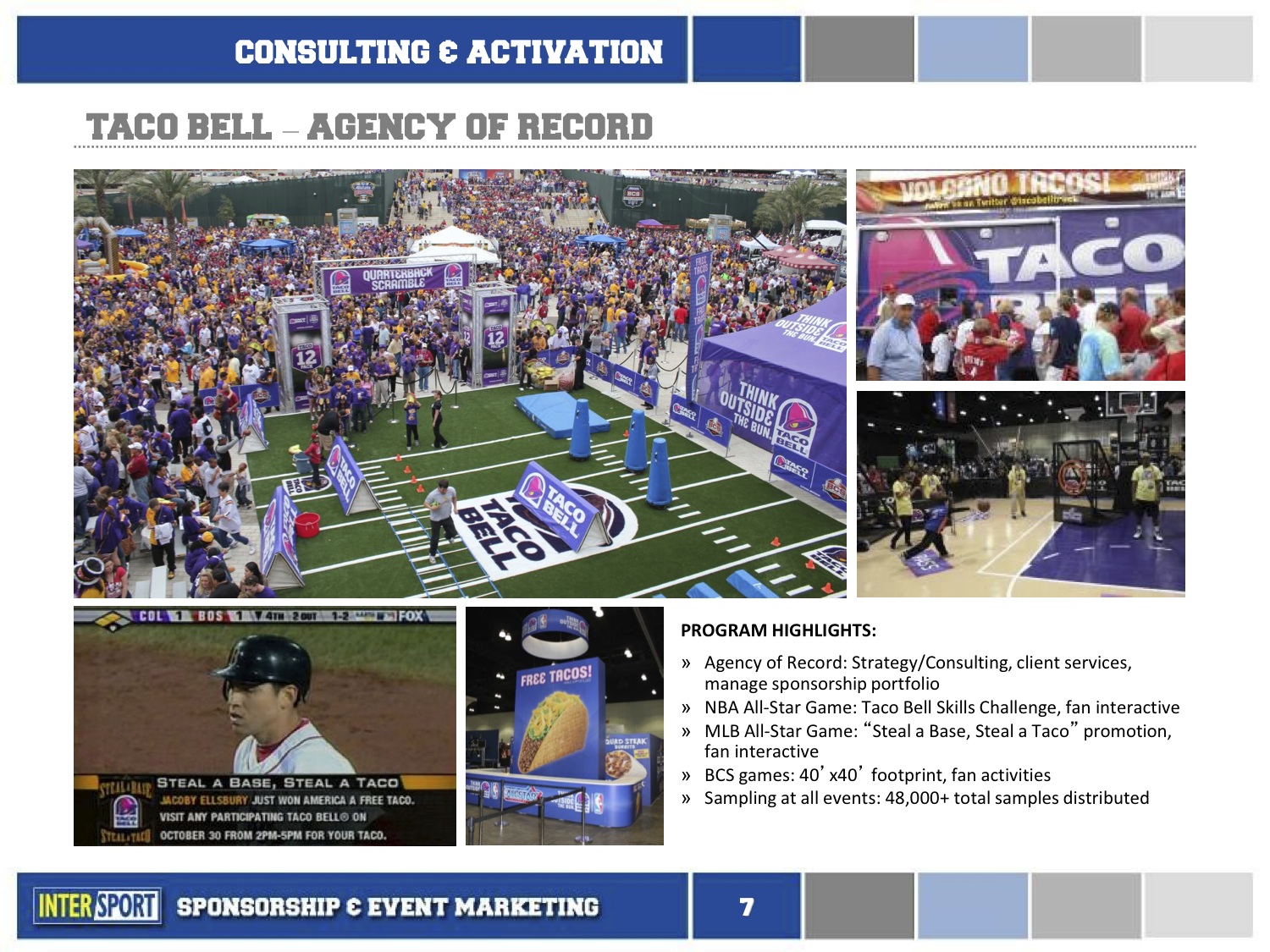
Intersport deals with a number of Fortune 500 clients on some of the biggest stages in sports around the globe. For example, Intersport is the sports marketing agency of record for Taco Bell. They handle all of the consulting, and activations in sports for Taco Bell, including the Taco Bell Skills Challenge during NBA All-Star weekend, a fan activation at the NBA All Star weekend which featured a mock run-through of the skills challenge for fans, and the “Taco Bell: Steal a Base, Steal a Taco” promotion at the MLB World Series.
 “We’re developing strategy for them, we’re negotiating their deals with teams, we’re executing, and at the grassroots level, we’re putting it all together for them.”
Intersport also consulted and led the renegotiation of Papa John’s Official NFl partnership at the conclusion of the 2012 Super Bowl.

Sponsorship Activation: 

Malaga talked about how the recent recession has made it increasingly difficult to prove to brands that sports can provide a return on investment.
“It used to be that a company might’ve just slapped their sign on Wrigley Field and paid a premium to do so. Now, companies really need proof that they will see a return on investment. The way to truly enhance sports marketing is thru activations – which is a word you’ll hear a lot – how can you create an experience for consumers around a sporting event?”

Malaga highlighted a variety of activations Intersport has done with General Motors at the Super Bowl, and at every Monday Night Football stop, in addition to other activations such as conducting the world’s largest game of knockout at the Final Four thru the Buick brand.


Owned Event Properties:

Intersport is also the agency of record for TD Ameritrade, and most recently consulted their sponsorships at the 2012 Olympics in London.

Intersport also helped TD Ameritrade activate their naming rights of the stadium in Omaha that annually hosts the College World Series. In order to gain further value from this deal, Intersport created the College Home Run Derby, a nationally televised event in front of over 20,000 fans in attendance at the TD Ameritrade Park.

Intersport also works with Under Armour for the annual Under Armour All-American Game which showcases 90 of the nation’s most talented high school football players. In this scenario, Under Armour is making an increased effort to reach the high school athlete and enhances the experience for them by hosting a full weekend of events including Combines, Practices, Skills Challenge, and the game itself which was coached by Mike Ditka and Steve Mariucci, and televised on ESPN.


Digital and Social Media:

One thing Malaga stressed was the importance of a social media influence. Intersport implements a strong social media strategy for all of their clients and events. However, he feels that it is widely misunderstood by others in the industry.
“You can have a gazillion Facebook likes if you want and that’s great, but are these consumers engaged with your brand? Sports can maximize the engagement with your brand if done the right way."
Malaga focused on a program on which they collaborated with Papa John’s called the “2011 Papa John’s Dunk of the Yea,r” which won the 2012 Cynopsis Award for Best Social Media Initiative. A description of the program, and it’s effectiveness in social media engagement can be seen below:


Corporate Hospitality:
“ A lot of people don’t talk about this, but every sports entity should include some sort of corporate hospitality. Business isn’t just about B2C (business to consumers) anymore, but also B2B (business to business).”
One example of this is the Double Eagle Club at Augusta – which is owned by Intersport and offers the highest end hospitality at the Masters. Companies can purchase a hospitality package that includes tickets and lodging, which can be used to entertain corporate clients.

The whole experience which starts with getting picked up in a limo, and also includes premium food and beverage throughout the day, cigar rolling, a PGA Pro golf swing analysis, a putting green, as well as the option to rent out a local Augustan residence near the course.


We are all grateful for this unique learning opportunity that Scott provided. Sports marketing is a broad, yet intricate, industry, and many club members had their first exposure to the field from this presentation.

We are thankful that Scott took the time to speak with us, and we look forward to staying connected with him moving forward! 

Labels: , , , , , ,

Wednesday, September 26, 2012

Event Preview: Gary Gertzog '80

9/28 - 4:25 PM - Ives 105

Please join the Cornell ILR Sports Business Society this Friday (9/28) at 4:25 pm in Ives 105 as we host Gary Gertzog '80!

Gertzog is the SVP of Business Affairs and General Counsel for the National Football League.

Gertzog joined the NFL in 1994 as Vice President and General Counsel of NFL Properties, Inc. Over the years, his role at the NFL has expanded to include overall legal and business affairs responsibility for the NFL’s commercial operations including media (television, radio, internet, wireless , etc.), marketing, consumer product licensing, corporate sponsorships, events and intellectual property. 

He has played a major role in a wide variety of complex commercial arrangements, including those involving new business models and deal structures, such as the NFL Master Agreement (which allocates intellectual property rights between the NFL and Member Clubs), the NFL’s unique sponsorship and internet agreements with NFL Players Association/Players Inc and industry setting deals for apparel, video game, credit card, beverage and telecommunication products and services.

He has also led the NFL’s efforts in important litigation matters including the protection of the intellectual property rights of the NFL and Member Clubs.

We hope to see you there!

Labels: , ,

Saturday, September 15, 2012

Event Preview: Scott Malaga '89

4: 25 pm - Friday, 9/21 - Ives 105 

Please join the Cornell ILRSBS on Friday, September 21 when we host Scott Malaga '89 for our first in-person speaker event of the semester!

Malaga serves as the SVP of Strategic Partnerships at Intersport - a leading sports, entertainment, and media marketing company. During this event, Malaga will have a presentation prepared outlining the field of sports marketing, with specific examples from his 15+ years of experience in the industry. As the Senior Vice President of Strategic Partnerships, Malaga oversees sales efforts for the Sponsorship & Event Marketing division at Intersport. Malaga has dealt with brands such as Taco Bell, State Farm, Under Armour, Geico, and Pepsi. He has then advanced their activations at forums such as the Super Bowl, the US Open, and the NBA All-Star Weekend.

He most recently served as the Vice President of Corporate Partnerships for the Chicago Fire. Prior to his stint with the Fire, he was the SVP and National Sales Director at ISP Sports, which was the nation's largest collegiate rights holder during Malaga's tenure.

At Cornell, Malaga majored in (what is now known as) Applied Economics and Management, and he was a first team all-Ivy League running back. He was inducted into the Cornell Athletic Hall of Fame in 1999.

** Please leave any questions you may have for Mr. Malaga below, and we may choose your question to ask at the event (and give you name recognition as well!) **

Labels: , ,

Wednesday, September 12, 2012

Event Recap: Ari Roitman '98 [Video]


The Cornell ILR Sports Business Society was fortunate enough to Skype with Ari Roitman on September 4th. Roitman is a ’98 Cornell graduate and currently serves as the Philadelphia Eagles’ Senior Vice President of Business.

Please read after the jump to hear about Roitman’s unique career path in sports, his role in the business behind the Eagles, initiatives they’ve have taken under his leadership, his career path, and much more!

On his role as SVP, Business:
“I essentially oversee a number of the revenue streams - I oversee all corporate partnership business, as well as our premium business which consists of suites, club seats, other premium products we sell, and then all of our media assets that can be monetized. That all falls under my jurisdiction. 
On a day-to-day basis, my old job (as VP of Corporate Sales & Marketing at the MLB) was much more grassroots – I was doing deals; I was at the forefront of negotiating partnerships. While I’m still doing that, my role is now that of a manager. I run a team with folks that are primarily responsible for doing those things, and my job is to make sure everything is running smoothly – that all of our partners are happy, that all of our commitments are being managed well. And also to keep in mind that we have a certain way we run our business, and making sure that we stay true to that."
On his years at Cornell:

Compared to others in the industry, Roitman’s educational background is unique. After finishing all of his prerequisites as a pre-med student, Roitman was on track to graduate as a pre-med student.

He recalls the particularly rigorous summer between his sophomore and junior.
“I took a full year of organic chemistry in 8 weeks, which I don’t recommend ever doing for anyone…ever again. It was Hell – 8 am to 11 pm every day, and not a single weekend night was spent out. It taught me something about myself.”
However, that summer allowed him to reflect on his life path.
“I just didn’t think I had another six to ten years left in me before I could become a full fledged member of the working force as a doctor."
Roitman transferred majors, and eventually graduated with a degree in Psychology.

Though Roitman had minimal business background, see how his Psych major helped him learn the most essential skill in sports business:


On his career path:

With no business background, but a deep passion for sports, Roitman’s first position after graduating was an unpaid internship at a Manhattan sports marketing firm that he got with the help of a Cornell professor.

The firm represented various sports broadcasters, and Roitman talked about the "less-than-fulfilling" work.
“I spent my first three months editing tapes of broadcasting talent like Chris Berman and Jack Edwards…my job was to edit their highlight reel tapes and making sure our VCR’s at the agency were recording broadcasts over night…not exactly what I went to Cornell for.” 
“The bottom line is that sports, like entertainment - and I don’t think this is a good thing, but it’s the way it is – it is very much a ‘pay-your-dues’ industry. If you have the attitude that you will do well with whatever ‘garbage work’ is thrown your way, then you will have the opportunity to do better work.”
And things did get better for Roitman. After eight months of the aforementioned “garbage work,” Roitman was then given the opportunity to work with the US Women’s National Soccer Team (who had just won the World Cup on American soil), where he was involved with management of their sponsors.

After two years with the women’s team, Ari had earned a position with MLB, where he would eventually go on to serve as the league’s VP of Corporate Sales & Marketing.

Roitman recalls his thought process behind a monumental decision in his career - when he decided to leave the MLB and join the Philadelphia Eagles in 2010. See what he valued, and heavily considered before making such a crucial move:


On the difference between working in partnerships in baseball and football:

Roitman was asked how his approach to business and partnerships changed as he went from the MLB to the NFL. However, he said the most substantial difference isn't working in a different sport. Rather, working on the league-side of the MLB (or any league for that matter) is considerably different than the team-side business.

What are some of the major differences between working on the business of league-side management and team-side partnerships?  See Roitman's explanation:


On how Eagles’ quarterback Michael Vick’s controversial history has not affected Eagles’ corporate partnerships:
“Something like that comes up, it’s never completely gone. The organization took a big gamble a couple years ago when we signed him. Whether or not you think it paid off in a football sense is irrelevant to me; obviously the more we win, the better off the business is going to be – there is a direct correlation there. But the bottom line is, people ask, and business partners ask. However, it was never and will never be a deterrent or get to the point where it prevents us from consummating a partnership or where it prevents us from selling a suite.”
“As an individual, if you believe in second chances, if you believe that people learn from their mistakes, and you want to judge them on how they live their lives after the fact…in my opinion he’s done a pretty good job, about as good of a job as you possibly can…I can’t say that it has affected the business, but it is very real, and we do get the question.”
On the Eagles' latest partnership, Angry Birds: 

Roitman was recently in the news discussing the recent partnership between the Angry Birds brand and the Philadelphia Eagles. In the press release, Roitman stated,
“This is a test of the waters type of partnership, and one that the Eagles desperately wanted to do first.”
See the business behind this deal - how it developed, the plans the Eagles have to integrate the Angry Birds brand, and the value in it for both partners - as well as a funny story Ari shares about Eagles' coach Andy Reid:


On initiatives the Eagles brand has taken to benefit the community and environment:

Though the overall goal for Roitman and the Eagles is to drive revenue, he also noted how much the organization values its positive impact the community.

Roitman discussed a partnership between the Eagles and NRG, which is a Princeton-based Fortune 250 Company. As a result of this partnership, there have been 11,000 solar panels and 14 wind turbines installed at the Lincoln Financial Field. That is enough to generate about one third of the power needed to run the stadium on an annual basis. The Eagles also have a “Go Green” platform that is a league-leading recycling program.
“Sustainability is a vital issue with our ownership, and it is very much in our DNA.”
Roitman also detailed the team’s community outreach. This past year, Beyond Sport recognized the Eagles for having the largest community impact from a sports team in the world. There was a conference in Cape Town, South Africa where the Eagles were awarded for their efforts in the community.

Some of these efforts include the Eagles' Bookmobile, which travels around the Philadelphia area every day to schools, shelters, libraries, recreation centers, and summer camps to read and give free books to children. This initiative is specifically geared to help alleviate the illiteracy epidemic in the area, and has had a significant impact.
“A couple of things are really important to the Philadelphia Eagles – outside of my core responsibilities and revenue generation and the football side of the house, sustainability and community outreach are two pillars that this organization can stand up and feel very good about.”
On whether the economy or improved home-viewing experience has affected luxury sales and premium seating:

According to Roitman, this is a real problem for other teams in the NFL, as well as other leagues. However, the Eagles have yet to face serious repercussions as a result of the recession.
“We are very fortunate to have a passionate fan base here, as well as a very forward-thinking ownership group, a very forward-thinking President, and it leads to very mature, sound business.”
To avoid having to sell these tickets each year, the Eagles look to lock up long-term deals with these consumers.
"We do all club seat tickets on five, seven, or nine year terms, instead of trying to resell every year. We’ve got a 40,000 person waiting list for season tickets, and so we’ve also got to get our premium buyers locked in. Long term, suites are either seven or ten year terms, but that is specific to our market.”
Though it may seem discouraging for potential buyers to lock themselves into a long-term deal like that, Roitman mentioned how valuable such an asset can be to a business.
“A premium purchase is often a business purchase – the organizations that are buying are doing it right, they doing things like looking at an ROI analysis before moving forward. So, if they’re investing $14,000 per year in premium tickets, what type of business did they wind up securing from the entertainment? Oftentimes, we call it a success story – if a deal closes, and one small reason for that is because you took a potential client to your suite for the Eagles/Giants Sunday Night Football game where Brian Dawkins’ number is retired, oftentimes the tickets pay for themselves and then some.”
On the NFL's decision to switch from Reebok to Nike as their official outfitter, and some obstacles the Eagles faced as a result:

This offseason, Nike succeeded Reebok as the NFL's official uniform outfitter. Club member Channing McNeal '15, an ILR student, asked how this new apparel partnership has affected the Eagles from a marketing and sponsorship standpoint.

See how the Reebok logo posed problems for the Eagles as they marketed LeSean McCoy, Michael Vick, and DeSean Jackson for this upcoming NFL season:


On his career advice for students in the room:

Rotiman was asked:

a) What is the best career advice you received along your journey?
b) What advice do you have for the students in room right now?

Roitman discussed how important it is to maintain healthy relationships along your career path. Though things may not consummate as planned, he stressed the importance of not burning any bridges with others.
"The blanket term I use is that 'it's a long life,' When you're young, and you're in business, and something doesn't go your way, it's very easy to get upset and fly off the handle....The bottom line is to always keep in mind that those things, in the grand scheme of things, are very, very small. You never want to do anything to burn bridges, and you never want to do anything that can damage relationships in the long term...Just because something doesn't hit when you want it to hit, doesn't mean that in a year, two years, even three years from now it won't happen."
Roitman told students that even though they might be "paying their dues" early in their careers, by no means is it a reason to get discouraged, but rather an opportunity to prove your worth.


We are thankful that Ari was able to take the time out of his schedule and join us for this Skype chat. Like our other events, this was a tremendous learning opportunity for our members, and we greatly appreciate the insight he provided us with.  We hope to remain closely connected with Ari moving forward.

Thank you to all who attended. We hope to see you for our next event later this month!

Labels: , , , ,

Wednesday, August 29, 2012

Event Preview: Ari Roitman '98


9/4 - 4:30PM - Ives 105

Please join us as we host Ari Roitman '98, Senior Vice President of Business for the Philadelphia Eagles via Skype!

A Cornell graduate with a degree in psychology, Roitman spent nine years in the MLB corporate offices where he eventually served as the VP of Corporate Sales & Marketing. In 2010, Roitman joined the Eagles, and has overseen revenue generation in corporate partnerships, premium sales, media, and strategy.

Get the chance to hear about the business behind the Eagles and the NFL - inside a deal with a corporate partner, team and player marketing, fan engagement, and more. Of course, Roitman will also be discussing his years at Cornell, his career path, as well as provide advice for aspiring sports business professionals.

To close the event, Roitman will be fielding some questions from the audience. Be sure to check out the Facebook event page to have the chance to be selected to ask your question! This will be our first event under our new name - the Cornell ILR Sports Business Society - that is part of our rebranding effort that will revamp and refocus our advancements in the sports industry.

We hope to see you on Tuesday, September 4th at 4:30PM in Ives 105!

Labels: ,

Thursday, April 26, 2012

Event Recap: Susan Schroeder '86 & Tom Cerasoli '00

On April 18th, the ILR Sports Management Club had the opportunity to Skype with fellow Cornellians Susan Schroeder ’86, Senior Vice President of Marketing Partnerships at Madison Square Garden, and her colleague, Tom Cerasoli ’00, the Director of Strategic Partnerships at Madison Square Garden. Club members were fortunate enough to get career advice and an in-depth perspective from two industry leaders. Schroeder and Cerasoli are part of a marketing team that oversees brand relations between Madison Square Garden and its corporate partners, including Delta Air Lines, JPMorgan Chase, and Coca-Cola. Read about the question and answer session after the jump.

How their differing professional experiences led and prepared them for marketing at Madison Square Garden

Though the two currently work together at MSG, the career paths they each took to get there were actually quite different. Cerasoli took the seemingly more common route upon graduating from the ILR School. He worked at United Talent Agency for nearly two years before deciding that the field was not fit for him. He then decided to get his MBA at the Isenberg School of Management at UMass, which he planned to use to enter the sports industry. After finishing school, his first job was at Velocity Sports & Entertainment where his quick ascension was a result of his passion, hard work, and savvy.  After nearly five years, he became the Senior Manager where he worked in corporate consulting for commercial brands such as Visa, AT&T, and FedEx while also managing relations with the NFL, NBA, NCAA, and Olympics. The value he added to Velocity prepared him to serve as the Director of Partnership Strategy for the World’s Most Famous Arena, where he has been for the past year.

Schroeder’s route, on the other hand, involved an extensive background in corporate marketing that was eventually molded into a sports-oriented position. After graduating with a degree in Agricultural Economics (now the Charles H. Dyson School at Cornell), Schroeder found work in an unconventional way. She admitted,
“You’re going to laugh when I tell you this, but the way I found my job was a bit unusual—I found an ad for a position with Mercedes Benz in the New York Times and I reached out to them.” 
She gave a dramatic pause for students to digest this for a second. The Ivy Leaguers in the room who couldn’t imagine job-hunting without their beloved LinkedIn profiles were in shock! At Mercedes, she worked in brand management creating merchandise, accessories, and e-catalogs. It was there where Schroeder started gaining her initial experiences in marketing and brand management. After her time at Mercedes, she began working in public relations for Formula One. Despite her lack of PR experience, her writing skills were helpful and she managed the affiliation with Mercedes, a brand she was already quite familiar with. After working a series of executive marketing positions at Porsche, Clear Channel Worldwide, and AMCI, she parlayed her skills and knowledge to impact Madison Square Garden and the sports industry.

Inside the deal of a Madison Square Garden corporate partnership

Both Schroeder and Cerasoli stressed that the most essential facet of their business approach is to “encourage and foster partnerships.” The Madison Square Garden Company has three subdivisions - MSG Sports, MSG Media, and MSG Entertainment. They are all composed of a long list of corporate partners, all of whom The Garden conducts business with in the same way. Not only is MSG looking to generate revenue, but they also want to form lasting relationships with these brands. Schroeder describes,
“We like to think around here that these partnerships are like marriages; we are looking for a relationship that can sustain itself long-term. Think about Coca-Cola, who has been an MSG partner for over 100 years.”
MSG is among the elite brands in sports and has the luxury of doing business with whomever they consider fit. Cerasoli described that any company inquiring about potential business must understand that,
“We’re not looking at our business in terms of transactions, like I said—we are trying to build relationships. The first thing we do is ask potential partners what the goals of their brand are and say, "okay, where is the fit for us?" We then find a middle ground that benefits both parties.”
Schroeder added,
“Take Delta, for example, one of our signature partners. How do we find ways for our New York Knicks fans to become Delta frequent fliers, and for Delta’s consumers to enjoy the benefits of the Garden?” 
Schroeder, Cerasoli, and the rest of the marketing team must use creative platforms that engage consumers such that they associate two brands with each other positively.

While the marketing team constantly works hard to create and cultivate these relationships, it does its due diligence before it ever enters such ventures. According to Cerasoli,
“Sometimes you have to just say no. Partnerships just don’t work best when your brands do not share the same values.”
If two brands do not have similar values and philosophies, it is difficult to create an efficient and successful partnership

On the impact of a Madison Square Garden corporate partnership

We all know that partnerships are made to result in economic gains for both parties. According to Schroeder, a product associated with MSG will reach up to 30-40% higher affinity for both brands in the eyes of the consumer. True, having so many partners is good for the Garden’s business. Nonetheless, Schroeder emphasized that the marketing team is always looking to “find that balance.” Tom added,
“Our content is very partner-driven, but we’re always trying to ‘thread the needle’ between branding and entertaining for our fans. You need to find that median, and it’s not always easy.”
The joint efforts between MSG and its partners can pay high dividends for both sides when such a balance is reached. Schroeder brought up a recent example in which Kia gave away a car to a Knicks fan after hitting a half court shot during halftime. However, this moment had deeper implications than the typical fan realizes. Schroeder explained,
“This was a moment -- a special moment -- where nearly 20,000 people are out of their seats screaming for a fan they’ve never seen or heard of. He hits that shot, he’s running around the court, celebrating and is even hugging Spike Lee! That was a special moment viewed by millions on YouTube and SportsCenter…and Kia owned that moment.” 

On the business behind "Linsanity"

Club members were eager to hear about the financial, off-the-court impact that fellow Ivy Leaguer Jeremy Lin had on MSG. Lin averaged only 12.9 points per game against Cornell in his collegiate days, went undrafted, got cut by two NBA rosters, and frequently went back and forth between the NBA and the D-League. While playing for the Knicks, he was repeatedly mistaken for their trainer and was nearly cut around midseason. Lin got his opportunity and ran away with it; he scored 109 points over his first four career starts which was the most by any player since the NBA/ABA merger. I then asked, “What changes did you see to your prospective roles in the midst of Linsanity?” You could immediately tell they had gotten that question a million times by the faces they made. Cerasoli joked, “Oh, I taught him everything he knows!”
“But seriously,” he continued, “Jeremy has had a tremendous impact – our ratings and brand affinity have both shot up, and existing partners certainly have recognized the value in this. ”
Schroeder added,
“And not to mention, it also gives us another face for the franchise. Last season adding Amar’e and Carmelo at a time where social media was taking off was huge for us. The New York Knicks have over 2.3 million likes on Facebook and have more team video views that all other 29 NBA teams combined.”
During, and ever since Linsanity, the MSG marketing team has been working closely with global companies. Since Lin is the first Taiwanese-American NBA player, his international influence from the Garden hardwood is immense. Though they were unable to get into specific details, they assured us that their lines were constantly ringing during the Lin craze. Not only were companies inquiring about opportunities with the Madison Square Garden Company, but they were also just looking for any channel through which to get in touch with Lin. “We’d get phone calls,” Schroeder smiled as she recalled, “with people just begging us, ‘how do we get in touch with Jeremy’s agent?’ Everything about Linsanity was just… incredible.” Club members are fully aware of how Linsane MSG’s executives were after having witnessed MSG Sports President Scott O’Neil present Rockets GM Daryl Morey with a signed Jeremy Lin jersey at the MIT Sloan Sports Analytics Conference as a “thank you” for cutting Lin in late December.

On the role of partnerships in the transformation of Madison Square Garden

The plans for the renovations of The Garden intrigued many club members. Over the years, many of us have seen some iconic moments happen live at MSG, yet the building has remained unchanged for the most part. Schroeder and Cerasoli together listed reasons why change was necessary: “Yankee Stadium, Citi Field, MetLife Stadium, Red Bull Arena…” and then the 800 pound gorilla in the room was acknowledged, “not to mention the new Barclay’s Center in Brooklyn…” The World’s Most Famous Arena has been getting a run for its money on its own turf, and they are working diligently to hold that title true.

So how can partnerships provide a solution to this issue at the new MSG? She continued,
“Anybody want to guess how the new Garden is being paid for? $900 million was purely funded by our corporate partners - no public tax funds.”
Some of the partners that will have a heavy influence on the new MSG include JPMorgan Chase, Delta, Coca-Cola, and Anheuser-Busch. Cerasoli said,
“Each of these partners have a different role, trying to target a specific consumer. For example, there will be the Delta SKY360° Club for a group of season ticket holders and features inclusive food and beverage. Delta wanted to find an intimate way to connect with our HVC’s [high value customers] who are affluent and are thus likely to travel more. By delivering high end, premium hospitality, we provide a forum for Delta to reach this market of HVCs.”
Other partner-driven initiatives include the Budweiser Fan Deck, the Chase Bridges, and Chase Square. In September 2010, Chase became Madison Square Garden’s first-ever Marquee Partner. The company will become MSG’s “preeminent, multi-platform, multi-venue, multi-media partnership,” according to the MSG Transformation website. The suspension bridges are going to be above the action at MSG, and will give consumers a one-of-a-kind view of their favorite events. Most of the plans for the Chase Bridges have been somewhat finalized; yet, the design for Chase Square is still being perfected. Schroeder said, “this is something that we are still working tirelessly on. Chase Square is going to be the entrance to MSG; how do we give fans that satisfaction and enjoyment that welcomes them to their experience? And not only that, but how can Chase help us provide that while promoting their services? That is something we will continue to figure out over the next 8 months.”

On how MSG’s wide range of events create partnerships

The Madison Square Garden brand is rivaled by few in terms of its prestige in sports, entertainment, and history. As Schroeder explains,
“I can guarantee to you that Madison Square Garden will never sell its naming rights-- it will never have to.” 
However, what makes the MSG brand so valuable is its versatility. Not only does it host the Knicks, Rangers, and Liberty home games, but also a wide range of entertainment events. Cerasoli said of their list of over 70 partners,
“They naturally will get varying exposure…we strategize our promotions as a way to reach our partners’ desired markets and demographics…we can provide that since we have a wide range of events, which means a wide ranged consumer base.”
The MSG brand is so strong that when companies look to do business with The Garden, the marketing team asks, “okay, what are you trying to do?” Schroeder followed up,
“Our signature partnership with Delta Air Lines is targeting our HVC’s that can be at any of our events, whether it be for basketball, hockey, boxing, or other entertainment. However, look at a company like Foot Locker. The target consumer base is much more specific, and so their influence is mostly felt at New York Knicks games.”
Cerasoli continued, “We have the opportunity to talk to anybody. What makes MSG more powerful is that we don’t have one voice.” To exhibit the team’s diverse success, the two recounted a recent Sesame Street show at MSG in which they hosted a milk and cookies party afterwards. The goal was to provide young kids with a “Garden moment” to hopefully remember forever, while also giving increased parents associated contentment with the Garden.

On the best career advice they have for students pursuing sports-related careers

 “I don’t think my advice is relevant considering I got a job through the New York Times,” Schroeder joked. “But, one thing I can tell you is that networking is a priority, it is absolutely key.” She encourages students to use resources such as Linkedin and sports conferences as opportunities to meet new people and expand your network. By doing so, “you never know what they can do for you down the road.” Susan also encourages students to
“Look for internships where the staff wants to help you… you want to work where people want to help you…My first boss was always a bit tough with me, and would always quiz me with these specific questions. I didn’t appreciate it at the time, but you need to take the good from your experiences; I know she was requiring me to be prepared and know extensively about what exactly I was doing.”
Cerasoli’s advice for sports business students was to take any experience you can get. “You don’t have to work at the NFL in order to work with the NFL. The NFL is great, don’t take that the wrong way, but there are many ways you can wind up working in sports, or working with the NFL. Don’t focus on one company or one position.” Tom told students not to be discouraged if our career goals get postponed. “You shouldn’t be concerned about the titles you hold, rather, it’s all about the lesson you learn from your experiences.”

We are so grateful that two industry leaders like Schroeder and Cerasoli were able to speak with the Cornell ILR Sports Management Club. Though students were drawn to this event for varying interests, their focus on the business of partnerships provided us with new perspective. We all look forward to applying this new insight the next time we watch MSG or go to the new Garden. We thank them for taking the time out of their schedules to speak with us, and we hope to stay connected with them in the future! 

Labels: , , , , , ,

Tuesday, April 17, 2012

Event Recap: Tim McDermott ('95)

On Wednesday, April 4th,  the ILR Sports Management Club was fortunate enough to host Philadelphia Eagles Senior Vice President and CMO Tim McDermott for a Skype video session. McDermott, a Cornell graduate, is responsible for strategizing and managing all marketing, advertising, merchandising, and brand extension efforts for the Eagles. At Cornell, he was an AEM major, and a three-year letter winner, a two-time GTE Academic All-America and an Academic All-Ivy League selection on the Big Red football team. Upon graduating from Cornell, McDermott worked various positions within the NFL for the Jacksonville Jaguars and San Diego Chargers before enrolling at Harvard Business School. Since, he has successfully managed the brands of the Washington Capitals and Eagles and was named to the 2011 Philadelphia Business Journal’s 40 Under 40.

The event was Q&A format, and McDermott shared some in-depth insight with club members on his field of work. Read about it after the jump.

On his career path, and what initially attracted him to sports

McDermott, unlike many graduates, knew exactly what he wanted to do professionally. His passion for business and his football acumen made the sports industry an especially intriguing field for him. His dad was a college football coach, and his brother, Sean, was also working in football. (Sean McDermott is now the defensive coordinator for the Carolina Panthers.) Thus, Tim wrote a letter to a Cornell alumnus that was working for the Jaguars looking for advice and an opportunity to work in the NFL. He ended up interning there for six months, and was offered a job working in team operations, sales, and marketing. McDermott had worked in Jacksonville for two years before getting an offer from the Chargers to become their Director of Sales.

Though McDermott was enjoying his time in San Diego, he still felt like there was more for him to learn in business. True, he knew about marketing, sales, strategy, and development, but he wanted to know how these facets of business are connected. He went to the Harvard Business School to further his education and the dividends paid off. After stints at Goldman Sachs and Comcast, McDermott served as the Senior Director of Marketing for the Eagles from 2004-2006 before working as the Senior VP and CMO for the Washington Capitals, leading the club’s marketing and communication efforts. After a complete turnaround of Washington’s brand identity and dramatic increases in the team’s popularity, McDermott returned back to Philadelphia in 2010 where he currently serves as their SVP and CMO.

On his work in Washington, and the difference between NHL and NFL.

Though McDermott worked the same position for the Capitals as he now does for the Eagles, his approach to business differed in many ways. As McDermott explained, in the NBA, MLB, and NHL, the main focus for an executive is in ticket sales. In Washington, “everybody became a sales person,” whereas in Philadelphia, “there’s a 40,000 person waiting list for season tickets - we don’t really have a sales-oriented culture here.” When he went to Washington, he observed the issues that many non-NFL teams experience, which mainly center on a lack of attendance and fan interest. “Here we had one of the game’s best players in Alex Ovechkin, and he was able to walk the streets of DC without being recognized.” He also mentioned that, for fans, it “didn’t feel cool to be here (at home games).” As a result, he made an effort to rebrand the identity of the Capitals by marketing the team as “younger, energetic, and edgier, almost rockstarish” and by changing their uniforms to fit this new theme.
The results were tremendous as the Capitals set franchise records in sellouts with all forty-one home games selling out for the first time in franchise history. Additionally, the Caps were among the NHL’s elite in marketing, media relations, community relations, game entertainment, and online presence.

On his work in Philadelphia, continuing on difference between the NHL and NFL.

While McDermott described work in the NHL to be centered around sales, he mentioned that the main concern in the NFL is consumer satisfaction. This is especially important given today’s current fan culture. In the age of fantasy football, HDTV, and NFL Sunday Ticket, one would think that it is more difficult to sustain in-game fan retention. However, under McDermott’s efforts, the Eagles brand strength increased 40% according to ESPN Sports Poll, and the team was recognized by Forbes as the fastest growing brand in all of sports.

McDermott said that the key to the team’s brand strength is their focus on consumer satisfaction and interaction. The Philadelphia executives are working to provide an in-game experience that is unmatched and superior to watching the game in your living room. One way they are doing so is exemplified in the plans for the renovations of the Lincoln Financial Field. McDermott mentioned how they are using fan study groups and research in order to tailor the stadium and seating to their liking.

On Michael Vick, and the management of players’ PR to enhance the Eagles’ brand

The Eagles, for many reasons, must be more aware of their team/player/fan relations than most other teams. For starters, the Eagles are in a large media market led by tough Philly fans. On top of that, fan interaction with players, organizations, and even other fans is at an all time high with the exponential growth of social media. The fans have unprecedented access to information on the internet, and it is thus important to make sure that players represent the Eagles in a way that agrees with their brand and philosophy.

For example, the Eagles’ most marketable player happens to be one of the most polarizing figures in sports. Michael Vick was signed by the Eagles two years after his arrest for a highly-publicized dog fighting scandal. While it was very difficult to market this acquisition in a positive light initially, McDermott commended the way Vick has conducted himself since. Vick has made an effort to be honest, open, regretful of his wrongdoings, a hardworking and supportive teammate, and a good citizen in order to successfully rebrand his image. Vick was among the top selling jerseys in the NFL in this past season.

McDermott said that teams in the NFL have implemented a system to educate players on social media management and what is okay to tweet or say in an interview. He stated, “The media is always watching your back, you have to monitor your players constantly.” However, he admits that even with proper coaching in this area, the players will sometimes says things with which you don’t agree. For example, a player dubbed last season’s squad as “the Dream Team" and put a massive target on the team's back.

On the best advice he received in his career

When Tim was at Harvard Business School, he interned at Goldman Sachs. He told a story about a time he was talking to an employee and asking him questions for insight and advice. Tired of hearing the same questions from interns, the gentleman turned to Tim and told him, “STOP! You all do the same exact thing. You all sit here and ask me the same ridiculous questions one after another.” Tim was at a loss for words, and the man continued, “If you’re going to come up to me to talk, bring something of value to this. Come to me with stocks I should buy or sell, give me research, GIVE ME SOMETHING.” Tim said that these words have stuck with him ever since. In anything you do professionally, he urges that you prove your worth by providing value to employers and your company.

The other piece of advice he got was from current NFL Commissioner Roger Goodell who told him, “What you do is important, but who you do it for and who you do it with is more important.”

On his advice for future leaders in sports

Along with the advice he shared from Commissioner Goodell and the Goldman Sachs executive, Tim mentioned that if you want to work in sports, you must be prepared to move elsewhere. He said, “in the sports world, there is only one director of marketing, one CEO, etc. One thing I have learned is that the only way to move up is move out.” McDermott’s career has led him from Pennsylvania to Cornell, Jacksonville, San Diego, Harvard, Washington DC, and back to Philadelphia. He said that though this was difficult for him, it mentally and emotionally prepared him for any potential changes in his life, which he finds rewarding.

McDermott also said that wherever you work, all executives should follow three basic rules: hire good people, require goal setting that holds people accountable, and provide the proper training to develop these individuals.
_ _

We’d like to again thank Mr. McDermott for taking the time out of his schedule to speak with ILRSMC members. As an organization looking to prepare students for sports business careers, these opportunities are invaluable to us. We not only learned about the basic functions of his position, but insight that we would not have access to otherwise. We appreciate his time, and hope to hear from him again in the near future.


Labels: , , , ,