Monday, October 6, 2014

Experience Spotlight - Eric Schwartz, GroupM


In this semester's Experience Spotlight series, the blog will be featuring Cornell ILR SBS members who have excelled in positions in the sports industry. Many talented Cornell students are making impressions all across the sports world, and this is their chance to showcase their experiences.

This week's Spotlight focuses on Eric Schwartz '15.  Eric is a senior in Cornell's School of Hotel Administration, where he majors in Hospitality Management and minors in Real Estate. Eric has been an active member of the club since his freshman year, attending several conferences and many other events.  He can be reached at ems388@cornell.edu.

Eric worked this summer with GroupM ESP (Entertainment & Sports Partnerships), serving as a Marketing Intern. He was kind enough to answer some questions about his experience.


What were some Day-to-Day responsibilities of the position?
My daily responsibilities included researching information that related to our clients, its competitors, and its target markets, as well as building a media plan that was presented in front of a panel of judges at the end of the internship.

How were you able to get the Internship?
I interned for GroupM ESP last summer, so I was able to use the connections that I made during my time there last summer to help me get an internship this summer.

How has this experience shaped your career plans?
This experience has helped me realize that I want to pursue a career in partnership management in the sports and entertainment industry, whether it be at an agency, a sports property, or a brand.

What advice would you give another student interested in a similar experience?
For anyone interested in learning more about the business behind sports marketing, working at an agency such as GroupM ESP is a great way to learn about the preparation and tasks related to implementing a successful marketing effort in the sports industry.

What was your favorite aspect of the experience?
My favorite part of the experience was being able to work on several different accounts at the same time so that I could really understand how different brands get involved in different sports.

Thank you to Eric and GroupM for allowing us to share this awesome experience. We hope you have learned about some of the wonderful opportunities that Cornell, the ILR School, and the ILR Sports Business Society can provide in the sports world. We hope to feature many more stories from students and employers this fall!

Labels: , , , , , ,

Monday, September 29, 2014

Experience Spotlight - Ashley Estrada, Anschutz Entertainment Group


In this semester's Experience Spotlight series, the blog will be featuring Cornell ILR SBS members who have excelled in positions in the sports industry. Many talented Cornell students are making impressions all across the sports world, and this is their chance to showcase their experiences.

This week's Spotlight focuses on Ashley Estrada '16.  Ashley is a senior in Cornell's Industrial and Labor Relations School, majoring in Industrial and Labor Relations. She is double-minoring in Business and Law & Society.

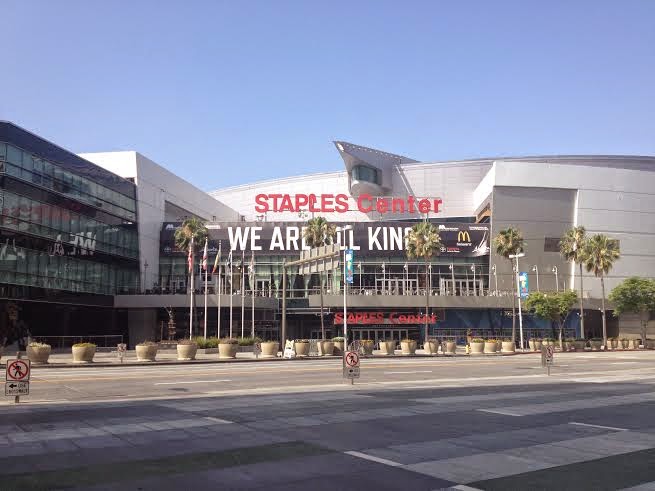
This summer, Ashley interned for AEG (Anschutz Entertainment Group), a sports and music entertainment company. The AEG Sports division owns several sports teams including her hometown teams; the Los Angeles Kings and the Los Angeles Galaxy, and owns shares of the Los Angeles Lakers. Ashley worked at the STAPLES Center, the home of the Lakers, Clippers, Sparks, and Kings. She served as a Marketing Intern and was kind enough to answer some questions about her experiences.
What are some Day-to-Day responsibilities of the position?

I performed various marketing activities througout the internship. My main responsibility was assisting with the development of the annual 3-day Nike Basketball 3on3 Tournament.

How were you able to get the Internship?
I got the internship through the help of a family friend who knows someone in the company.

How has this experience shaped your career plans?
My experience at the STAPLES Center validated my desire to work in a sports and/or entertainment company and reminded me to keep branching out and meeting people who could potentially help me land a position in these difficult-to-enter industries.

What was your favorite aspect of the experience?
Some of my favorite memories of the internship are attending the LA Kings' fan fest and pep rally after winning their second Stanley Cup championship, working the Nike Basketball 3on3 Tournament, and attending the LA Clippers fan fest held to celebrate the team's new owner, Steve Ballmer. If anyone has questions or wants to know more about my experience and/or the company, feel free to send me a message at ae282@cornell.edu.


Thank you to Ashley and AEG for allowing us to share this awesome experience. We hope you have learned about some of the wonderful opportunities that Cornell, the ILR School, and the ILR Sports Business Society can provide in the sports world. We hope to feature many more stories from students and employers this fall!

Labels: , , , , , , ,

Monday, September 23, 2013

Event Recap: Hussain Naqi ('97)

 
On Tuesday September 17th, Hussain Naqi ('97) was kind enough to speak to the Sports Business Society via Skype. Seventy-three club members attended the first event in SBS's Speaker Series.  A graduate of the Industrial and Labor Relations School, Hussain currently serves as the Senior Vice President of Fan Engagement for the Jacksonville Jaguars.

In his role, Naqi is responsible for the Jaguars’ marketing and branding efforts, overseeing the Jaguars’ game day experience, and managing the Jaguars’ fan development efforts in the UK.

Prior to joining Jacksonville in 2012, Naqi served as Vice President of Business Planning and General Counsel at MetLife Stadium. Naqi has worked in sports since 1997; his resume includes stints with the National Football League, NCAA, Major League Baseball, and the New York Mets.

For a look back at all of the social media surrounding the event, check out our Storify post, which chronicles all of the Twitter activity surrounding the event.  The rest of the full recap is right here, after the jump.

The Skype call started with a conventional Q&A session, where Naqi discussed his career path, his current role with the Jaguars, and general sports business issues.  But then the event turned to Twitter, as our guest responded to the over 40 questions tweeted by our club members. Our club experienced tremendous growth in social media presence, with the #CornellSBS hashtag being used over 50 Times, and the twitter handle @CornellSBS gaining 35 New Followers.  We would like to thank Mr. Naqi, as well as our existing and new club members for directly making this happen. 

Naqi spoke of the challenges of working for the Jaguars, namely the small market size and the fact that the on-field product has not been particularly attractive of late. He emphasized that to overcome these challenges he and his team work to directly engage the fan. He stressed the importance of stripping away "any excuse [a fan] has for not coming to a game", such as the inability to watch other games, restricted access to the internet and their fantasy teams, or long lines for concessions.

On the topic of breaking into the sports industry, Naqi maintained that there are a multitude of different paths a prospective student can take, and that there are a wide-ranging array of skills needed in sports business. He offered this advice for any students interested in sports business: "Network and hustle as much as you can. Understand that it is a marathon and not a sprint”.

The Jaguars are heavily involved in London, where they will play one game a year, costing them a game in Jacksonville, for the next four years. When asked about reconciling the interests of the team in both Jacksonville and London, Naqi explained the key role transparency with each group of fans played. The Jaguars display that they care about the Jacksonville fans, but they acknowledge that the market has its limitations. The massive financial gains from playing games in Great Britain, where there are roughly two million fans of American Football, can offset some of those limitations the franchise endures by playing in a small market.


One of the challenges the Jaguars faced when the new ownership group took over was that the stadium was outdated in many facets.  Because the stadium is owned by the city, the team has been unable to modernize their facilities in the manner many NFL teams have done. Naqi saw an opportunity to convert an underutilized hospitality lounge in the stadium into a place for fans to get away from the heat, the lounge is air-conditioned, and check up on how their fantasy teams are doing. The lounge, which is open to any and all fans, is outfitted with high-density wifi, televisions, tablets, and "very comfortable recliners" .


Hussain explained that the Orlando CBS affiliate, which is obligated to show Jaguars game, had been mistakingly promoting the Broncos-Giants game being played at the same time. Once they realized that they had to show the Jaguars-Raiders game, they apologized for the confusion. Our guest was able to offer additional insight into the complex relationship between the NFL, teams, and television networks and their affiliates. 


Hussain explained this is actually a part of a league-wide program to expose unruly fans and increase safety for others.  This initiative plans to reduce safety concerns and offensive behavior in general, which is very much in line with the Jaguars' mindset of eliminating excuses for fans to not come to games.


Hussain stressed that the Jaguars do in fact conduct quite a bit of research into their fan base, but also stressed the importance of differing levels of validity this research can have. For example, Hussain brought up the rally held by fans in the stadium parking lot this past Monday advocating for the team to sign Tim Tebow. While it was heavily reported by the national media, the rally only drew 16 fans, indicating that there wasn't nearly as much fan interest in Tebow as the national media wishes there was.

For a look back at all of the social media surrounding the event, check out our Storify post, which chronicles all of the Twitter activity surrounding the event.

As always, ILRSBS extends its thanks to alumni like Hussain Naqi who take time to share their experiences with our members. The information and insight people like Hussain provide to our group is unique and indispensable, and we hope that this is the first of many great events with him.

Labels: , , , , , , , ,

Wednesday, September 18, 2013

Event Recap: Rachel Jacobson ('96)


On Tuesday March 12, the ILR Sports Business Society was fortunate enough to host alumnus Rachel Jacobson for a meeting via Skype. Rachel, a 1996 graduate of Cornell’s School of Hotel Administration, currently serves as the Senior Vice President of Business Development for the National Basketball Association.

Rachel Jacobson has worked for the NBA since she graduated from Cornell. She started in the entry-level rotational training program, working for many different departments within the NBA. She partly attributes getting the job to the training ground for immediate impact that Cornell, and the Hotel School, provided her. After a year in the rotational program, it was time for her to decide what was next – she decided that marketing was the best fit for her, so she joined the Global Merchandising Group, before moving to Marketing Partnerships.

 Rachel’s first major project was to find partners for the USA basketball team, a property of the NBA, for the 2000 Olympics in Sydney, where the USA took home the gold medal. Over the next four years, Rachel’s main responsibility was to manage these partners and identify potential new partners for USA basketball in its journey to Athens for the 2004 Olympics.


2000 US Men's Basketball Team
 
In 2005, Rachel saw a great opportunity for her to transfer her skills managing partners to selling them on the business side. She joined the Global Business Development group, which in addition to selling partnerships, also was tasked with creating social good within the communities with which it interacted. Rachel has worked in this department since then, now assuming the role of Senior Vice President, Business Development.

 On switching roles…

 Rachel had an easy transition from Marketing Partnerships to Business Development, largely due to the strong relationships she developed and maintained. Also, in her new role she still got to do marketing, just in a new way; instead of the day-to-day marketing, her new role was more about staying engaged and involved with the NBA’s sold platforms, while also seeking new brands to connect with.

 On the NBA’s marketing…

A main focus of the NBA’s marketing plan is to emphasize the purity of the game, such as the “Where amazing happens” campaign. The NBA wants to show how fun and exciting the game can be, and often does this through humor, as that is what they have identified that the fans love.
 

Heat F LeBron James in the midst
of his pregame ritual.
Also, the NBA wants the fans to be able to get a good look at what the players are doing, and for them to get closer to the game. This can be done through showing the teams in the locker room, the players doing their pregame rituals, or by having a player or coach “wired” for the game, amongst other ways. An additional example she shared was the Miami Heat’s version of the Harlem Shake. Basically, the NBA tries to deliver the fans a real experience that is fun and enjoyable.


 On franchise relocation…

 When asked about how franchise relocation affects her job, Rachel stated that it really doesn’t affect her too much. This is because the NBA has penetration in most significant markets either through its own league, the WNBA, the NBA Developmental League, or USA Basketball, as these are all the NBA’s properties. As an example, she offered the Nets relocation from New Jersey to the Barclays Center in Brooklyn; this move generated excitement around an organization that had been struggling and an area ready to embrace basketball. Change is good for the league; it just needs to be executed properly.


 On the recent NBA lockout…

 Rachel stated that the lockout didn’t detriment the NBA’s marketing partnerships too much, thanks to the strong relationships with their sponsors and the patience of these sponsors. It also helped that the fans were very forgiving! The major issue that the NBA faced, though, was an uncertainty of the date of return; however, they were still able to make many deals during the lockout and thrived out of the gate. Rachel also pointed out that if a brand wasn’t comfortable partnering with the NBA during the lockout, a partnership between the two probably wasn’t right anyway.

 On gender in the workplace…

 
WNBA star Lisa Leslie
with her daughter Lauren.
 Rachel insists that being a female in what is thought to be a “male industry” is not something she has thought about throughout her career, as she has never experienced gender issues. If anything, she says that it makes her more unique, and her status as a “working mom” helps her work with the WNBA, as this is what the league symbolizes. She also believes her status as a “working mom” motivates her to work more efficiently in the office.

 Advice for students…

 Rachel offered great advice to all of the students. One of the things she said was to “sweat the details” and not let things that seem small slip by. Also, it is good to personalize whatever you are doing, by finding a way to stand out. While doing this though, it is crucial stay humble and genuine by talking from the heart. Furthermore, when working for an organization, you should make sure you fully understand the organization, and work hard for it. Lastly, she stressed that, no matter what, you need to have fun!

 Again, we’d like to thank Rachel Jacobson for taking the time to speak with members of our club. It was an incredibly informative and insightful discussion, which we all truly enjoyed and appreciated.


Labels: , , , , , , ,

Wednesday, October 3, 2012

Event Recap: Scott Malaga '89

The ILRSBS E-Board with Scott Malaga, 9/21/12

On Friday, September 21st, the ILR Sports Business Society hosted former Cornell Big Red football captain, Scott Malaga ’89, who now serves as the Senior Vice President of Strategic Partnerships at Intersport.

As SVP, Strategic Partnerships, Malaga oversees the sales efforts for the Sponsorship & Event Marketing division at Intersport, which is a sports, entertainment, and media marketing company based in Chicago.

Before joining Intersport, Malaga had over fifteen years of experience in sports marketing, and most recently served as the Chicago Fire’s SVP of Corporate Partnerships.

Club members were provided with a unique presentation from Malaga, in which he discussed career path, and outlined the field of sports marketing with specific case studies from his career.
“You could’ve invited someone who spent 25 years with the Yankees, or someone who spent their entire career at the NHL, and they’d focus mainly on that. Sports marketing is a very broad industry, a broad term, and a broad definition. I have had many stops along my career in numerous areas of the sports marketing spectrum, and those experiences are what you can learn from me.”
On his collegiate years:

Malaga graduated from Cornell in 1989 as a business management major and dual sport athlete. While playing centerfield on the baseball team, he was also the captain of the Big Red football team. Malaga was the starting running back for the team that won the 1988 Ivy League Championship and is a member of the Cornell Athletic Hall of Fame.

Near his Cornell graduation, Malaga attended an event at the Johnson Business School featuring an executive from the Baltimore Orioles. At the time, the sports industry wasn’t common to enter, so Malaga asked him how he could get his foot in the door. He was referred to Ohio University, where he earned his masters in Sports Management.

On his early years in sports marketing:

Malaga’s first job upon graduating from Ohio University was with a company that bought the licensing rights for Champion Footwear. His main responsibility was to travel to NFL and NBA teams, as well as universities to sign athletes and programs to shoe contracts. To do this, he had to have a strategy. Here, it was to develop relationships with each team’s equipment manager.
“I would fly to Kansas City, rent a car, drive to the Chiefs’ facilities, talk to their equipment manager, and ask about players that didn’t have contracts AND were visible. I’d meet with those players, and if I felt they would give us exposure, I’d sign them to a contract Then I’d drive my car back to the airport, go to Denver, rent a car, meet the Broncos’ equipment managers, do the same thing, fly to Los Angeles - this time rent a convertible - and do the same thing over again. My strategy was to develop relationships with these equipment managers who were accessible and knew what was going on within the team.”
After all of that traveling, and to move closer to his family, Malaga decided to quit his job and move to Chicago. Simply put, he said,
“Don’t quit a job, and this is especially true in sports, unless you have another job lined up. I found out the hard way, spending the next 8 months looking for work.” 
Malaga found a job with Kellogg’s working in their food service division, where he utilized sports to sell their products to distributors and institutions. For example, when Kellogg’s had a deal with a sports entity, he created an incentive-based program that provided X tickets to that entity, for every Y number of cases of cereal sold to their distributors and/or consumers.

On his return to Cornell and beyond:

Though his job at Kellogg’s was somewhat connected to sports, Malaga was looking for something more directly involved. At his five-year reunion at Cornell, he was asked to work in Athletic Public Affairs in a fundraising role for the Athletic Department. He created the Cornell Football Association, which is over 3,000 members strong, and eventually spawned the Ivy Football Association.

However, after 2 years, he wanted something else. So Malaga left the Cornell Athletic Department, and went to work in a revenue-driving role in sports. He had stops at Advantage International, Host Communications, Inc. , and ISP Sports where he mostly sold collegiate multimedia rights. At Host Communications and ISP Sports, Scott was involved in the beginning of the whole “multimedia rights bit in college sports.” He said,
“The trend started developing where companies would take the risk, buy the rights from these big schools, and then resell them. The universities loved it because they were guaranteed revenue.”
Both Host Communications and ISP were bought out by IMG College, which now has a stranglehold on the collegiate rights business.


On his work with the Chicago Fire, and the search for a new jersey partner:

In 2009, Malaga was offered to serve as the VP of Corporate Partnerships for the Chicago Fire. He admitted that he “didn’t know a thing about soccer.” But he always wanted to work on team-side marketing where he could influence ticket sales, marketing, community relations, and corporate sponsorships. He was also enticed by the fact that soccer was an international sport, and that the MLS was a growing brand.

In the beginning of his tenure, the Fire were informed that Best Buy would not be renewing their $2.7 million/year deal to be their official jersey partner. Malaga showed club members the marketing deck that was used to gauge interest from potential brands.
“To find a brand that was looking to spend $2.7 million for a jersey partner for the Chicago Fire, you had to find the perfect storm – we were looking at CMO’s of Chicago-based companies, CMO’s that were looking to utilize soccer, or in international markets, and/or interested in reaching the Hispanic market because 50% of our fanbase was Hispanic.” 
 “We then started talks with Quaker Oats. A guy on my staff who used to work at Coke for 20 years, and he had a friend that was now the VP of Supply Chain at Quaker Oats, who introduced us to their president. The Quaker Oats president is from Mexico, and when running the Quaker Oats brand in Mexico, he made one of their products (Gamesa) the jersey partner for a Mexican soccer club. This was an executive who loved soccer, and saw how much revenue soccer could bring the Quaker Oats brand. Quaker Oats was looking to eat into Kellogg’s market share in Chicago, and they emphasized the values of health, fitness, kids, and nutrition. All of a sudden, we had the perfect marriage.”
A deal was finally agreed upon, and Quaker Oats and the Fire began their collaboration for activations. First, the Fire created the Quaker Corner at the Toyota Park, which was a whole section branded by Quaker Oats, where products were constantly handed out. Another important initiative was the Fire’s integration of Quaker Oats into local Chicago youth soccer tournaments.
“We wanted to expand the reach of the Fire and Quaker Oats broader into the community. Every year, there are four major youth soccer tournaments in Chicago featuring over 450 teams. We not only could reach kids, but there are also parents that are stuck there for the day because each team played multiple games. So I met with all the leaders of the tournaments, and asked to sell into their tournaments in exchange for a small share of our revenue.”
The Fire directly integrated the Quaker Oats brand into this marketing by having signage at over 40 fields, and handing out product to kids and parents throughout the day.

 Read Joe Favorito’s latest blogpost regarding the Fire’s most recent initiative with Quaker Oats

Intersport Presentation: 

 Malaga left the Chicago Fire in 2011 to work in the sponsorship and events marketing division at Intersport, where he focuses on client relations. Upon getting his new position, he said, 
“My career hasn’t been specific in one field, and now, since Intersport offers so much, I can fall back on each experience and apply it in some small way – I know a little about a lot.” 
Malaga shared with us a marketing deck that Intersport sends brands to outline their services in sports marketing. Here is what he had to say about some of these services:

Consulting:

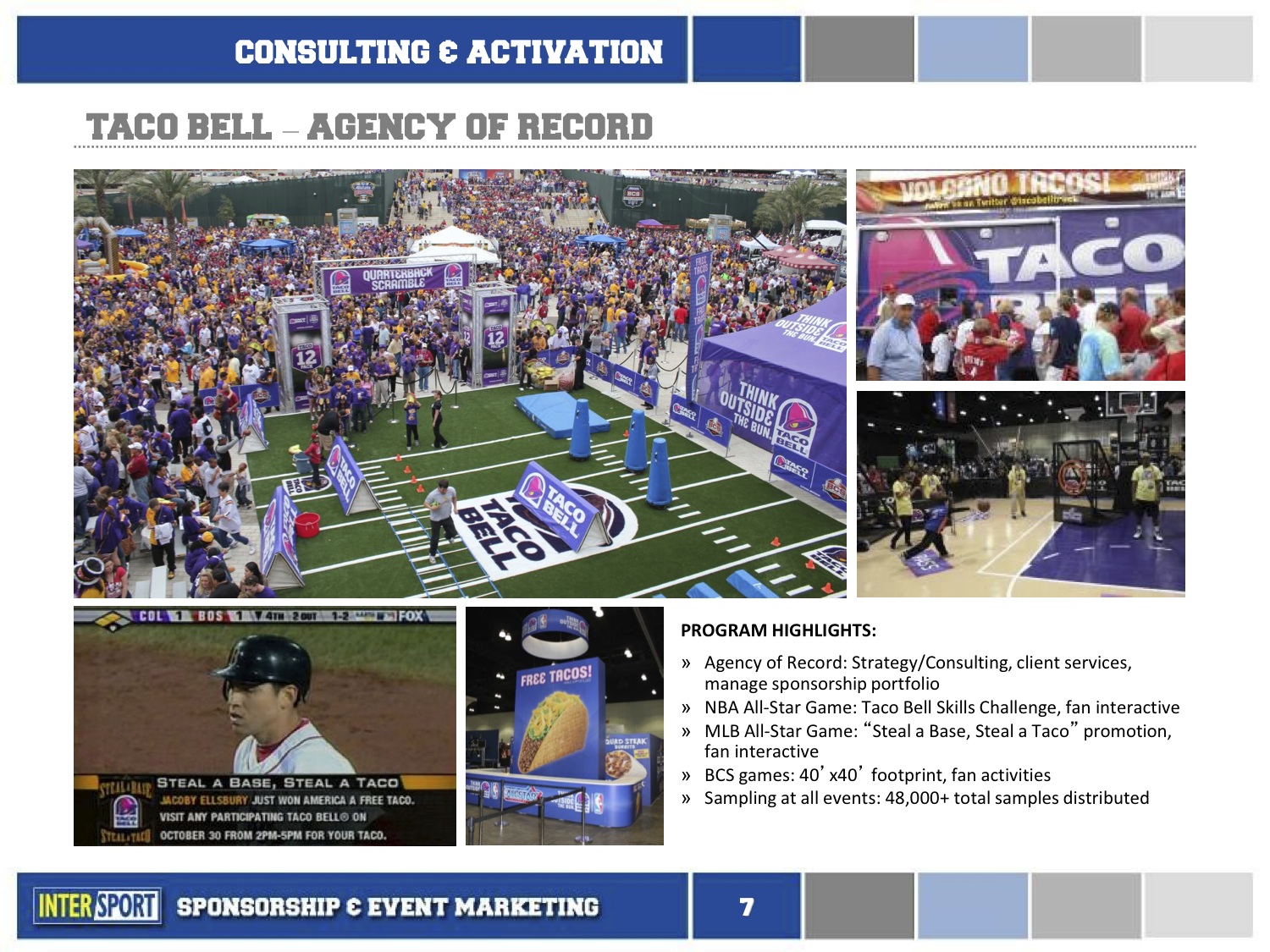
Intersport deals with a number of Fortune 500 clients on some of the biggest stages in sports around the globe. For example, Intersport is the sports marketing agency of record for Taco Bell. They handle all of the consulting, and activations in sports for Taco Bell, including the Taco Bell Skills Challenge during NBA All-Star weekend, a fan activation at the NBA All Star weekend which featured a mock run-through of the skills challenge for fans, and the “Taco Bell: Steal a Base, Steal a Taco” promotion at the MLB World Series.
 “We’re developing strategy for them, we’re negotiating their deals with teams, we’re executing, and at the grassroots level, we’re putting it all together for them.”
Intersport also consulted and led the renegotiation of Papa John’s Official NFl partnership at the conclusion of the 2012 Super Bowl.

Sponsorship Activation: 

Malaga talked about how the recent recession has made it increasingly difficult to prove to brands that sports can provide a return on investment.
“It used to be that a company might’ve just slapped their sign on Wrigley Field and paid a premium to do so. Now, companies really need proof that they will see a return on investment. The way to truly enhance sports marketing is thru activations – which is a word you’ll hear a lot – how can you create an experience for consumers around a sporting event?”

Malaga highlighted a variety of activations Intersport has done with General Motors at the Super Bowl, and at every Monday Night Football stop, in addition to other activations such as conducting the world’s largest game of knockout at the Final Four thru the Buick brand.


Owned Event Properties:

Intersport is also the agency of record for TD Ameritrade, and most recently consulted their sponsorships at the 2012 Olympics in London.

Intersport also helped TD Ameritrade activate their naming rights of the stadium in Omaha that annually hosts the College World Series. In order to gain further value from this deal, Intersport created the College Home Run Derby, a nationally televised event in front of over 20,000 fans in attendance at the TD Ameritrade Park.

Intersport also works with Under Armour for the annual Under Armour All-American Game which showcases 90 of the nation’s most talented high school football players. In this scenario, Under Armour is making an increased effort to reach the high school athlete and enhances the experience for them by hosting a full weekend of events including Combines, Practices, Skills Challenge, and the game itself which was coached by Mike Ditka and Steve Mariucci, and televised on ESPN.


Digital and Social Media:

One thing Malaga stressed was the importance of a social media influence. Intersport implements a strong social media strategy for all of their clients and events. However, he feels that it is widely misunderstood by others in the industry.
“You can have a gazillion Facebook likes if you want and that’s great, but are these consumers engaged with your brand? Sports can maximize the engagement with your brand if done the right way."
Malaga focused on a program on which they collaborated with Papa John’s called the “2011 Papa John’s Dunk of the Yea,r” which won the 2012 Cynopsis Award for Best Social Media Initiative. A description of the program, and it’s effectiveness in social media engagement can be seen below:


Corporate Hospitality:
“ A lot of people don’t talk about this, but every sports entity should include some sort of corporate hospitality. Business isn’t just about B2C (business to consumers) anymore, but also B2B (business to business).”
One example of this is the Double Eagle Club at Augusta – which is owned by Intersport and offers the highest end hospitality at the Masters. Companies can purchase a hospitality package that includes tickets and lodging, which can be used to entertain corporate clients.

The whole experience which starts with getting picked up in a limo, and also includes premium food and beverage throughout the day, cigar rolling, a PGA Pro golf swing analysis, a putting green, as well as the option to rent out a local Augustan residence near the course.


We are all grateful for this unique learning opportunity that Scott provided. Sports marketing is a broad, yet intricate, industry, and many club members had their first exposure to the field from this presentation.

We are thankful that Scott took the time to speak with us, and we look forward to staying connected with him moving forward! 

Labels: , , , , , ,

Thursday, April 26, 2012

Event Recap: Susan Schroeder '86 & Tom Cerasoli '00

On April 18th, the ILR Sports Management Club had the opportunity to Skype with fellow Cornellians Susan Schroeder ’86, Senior Vice President of Marketing Partnerships at Madison Square Garden, and her colleague, Tom Cerasoli ’00, the Director of Strategic Partnerships at Madison Square Garden. Club members were fortunate enough to get career advice and an in-depth perspective from two industry leaders. Schroeder and Cerasoli are part of a marketing team that oversees brand relations between Madison Square Garden and its corporate partners, including Delta Air Lines, JPMorgan Chase, and Coca-Cola. Read about the question and answer session after the jump.

How their differing professional experiences led and prepared them for marketing at Madison Square Garden

Though the two currently work together at MSG, the career paths they each took to get there were actually quite different. Cerasoli took the seemingly more common route upon graduating from the ILR School. He worked at United Talent Agency for nearly two years before deciding that the field was not fit for him. He then decided to get his MBA at the Isenberg School of Management at UMass, which he planned to use to enter the sports industry. After finishing school, his first job was at Velocity Sports & Entertainment where his quick ascension was a result of his passion, hard work, and savvy.  After nearly five years, he became the Senior Manager where he worked in corporate consulting for commercial brands such as Visa, AT&T, and FedEx while also managing relations with the NFL, NBA, NCAA, and Olympics. The value he added to Velocity prepared him to serve as the Director of Partnership Strategy for the World’s Most Famous Arena, where he has been for the past year.

Schroeder’s route, on the other hand, involved an extensive background in corporate marketing that was eventually molded into a sports-oriented position. After graduating with a degree in Agricultural Economics (now the Charles H. Dyson School at Cornell), Schroeder found work in an unconventional way. She admitted,
“You’re going to laugh when I tell you this, but the way I found my job was a bit unusual—I found an ad for a position with Mercedes Benz in the New York Times and I reached out to them.” 
She gave a dramatic pause for students to digest this for a second. The Ivy Leaguers in the room who couldn’t imagine job-hunting without their beloved LinkedIn profiles were in shock! At Mercedes, she worked in brand management creating merchandise, accessories, and e-catalogs. It was there where Schroeder started gaining her initial experiences in marketing and brand management. After her time at Mercedes, she began working in public relations for Formula One. Despite her lack of PR experience, her writing skills were helpful and she managed the affiliation with Mercedes, a brand she was already quite familiar with. After working a series of executive marketing positions at Porsche, Clear Channel Worldwide, and AMCI, she parlayed her skills and knowledge to impact Madison Square Garden and the sports industry.

Inside the deal of a Madison Square Garden corporate partnership

Both Schroeder and Cerasoli stressed that the most essential facet of their business approach is to “encourage and foster partnerships.” The Madison Square Garden Company has three subdivisions - MSG Sports, MSG Media, and MSG Entertainment. They are all composed of a long list of corporate partners, all of whom The Garden conducts business with in the same way. Not only is MSG looking to generate revenue, but they also want to form lasting relationships with these brands. Schroeder describes,
“We like to think around here that these partnerships are like marriages; we are looking for a relationship that can sustain itself long-term. Think about Coca-Cola, who has been an MSG partner for over 100 years.”
MSG is among the elite brands in sports and has the luxury of doing business with whomever they consider fit. Cerasoli described that any company inquiring about potential business must understand that,
“We’re not looking at our business in terms of transactions, like I said—we are trying to build relationships. The first thing we do is ask potential partners what the goals of their brand are and say, "okay, where is the fit for us?" We then find a middle ground that benefits both parties.”
Schroeder added,
“Take Delta, for example, one of our signature partners. How do we find ways for our New York Knicks fans to become Delta frequent fliers, and for Delta’s consumers to enjoy the benefits of the Garden?” 
Schroeder, Cerasoli, and the rest of the marketing team must use creative platforms that engage consumers such that they associate two brands with each other positively.

While the marketing team constantly works hard to create and cultivate these relationships, it does its due diligence before it ever enters such ventures. According to Cerasoli,
“Sometimes you have to just say no. Partnerships just don’t work best when your brands do not share the same values.”
If two brands do not have similar values and philosophies, it is difficult to create an efficient and successful partnership

On the impact of a Madison Square Garden corporate partnership

We all know that partnerships are made to result in economic gains for both parties. According to Schroeder, a product associated with MSG will reach up to 30-40% higher affinity for both brands in the eyes of the consumer. True, having so many partners is good for the Garden’s business. Nonetheless, Schroeder emphasized that the marketing team is always looking to “find that balance.” Tom added,
“Our content is very partner-driven, but we’re always trying to ‘thread the needle’ between branding and entertaining for our fans. You need to find that median, and it’s not always easy.”
The joint efforts between MSG and its partners can pay high dividends for both sides when such a balance is reached. Schroeder brought up a recent example in which Kia gave away a car to a Knicks fan after hitting a half court shot during halftime. However, this moment had deeper implications than the typical fan realizes. Schroeder explained,
“This was a moment -- a special moment -- where nearly 20,000 people are out of their seats screaming for a fan they’ve never seen or heard of. He hits that shot, he’s running around the court, celebrating and is even hugging Spike Lee! That was a special moment viewed by millions on YouTube and SportsCenter…and Kia owned that moment.” 

On the business behind "Linsanity"

Club members were eager to hear about the financial, off-the-court impact that fellow Ivy Leaguer Jeremy Lin had on MSG. Lin averaged only 12.9 points per game against Cornell in his collegiate days, went undrafted, got cut by two NBA rosters, and frequently went back and forth between the NBA and the D-League. While playing for the Knicks, he was repeatedly mistaken for their trainer and was nearly cut around midseason. Lin got his opportunity and ran away with it; he scored 109 points over his first four career starts which was the most by any player since the NBA/ABA merger. I then asked, “What changes did you see to your prospective roles in the midst of Linsanity?” You could immediately tell they had gotten that question a million times by the faces they made. Cerasoli joked, “Oh, I taught him everything he knows!”
“But seriously,” he continued, “Jeremy has had a tremendous impact – our ratings and brand affinity have both shot up, and existing partners certainly have recognized the value in this. ”
Schroeder added,
“And not to mention, it also gives us another face for the franchise. Last season adding Amar’e and Carmelo at a time where social media was taking off was huge for us. The New York Knicks have over 2.3 million likes on Facebook and have more team video views that all other 29 NBA teams combined.”
During, and ever since Linsanity, the MSG marketing team has been working closely with global companies. Since Lin is the first Taiwanese-American NBA player, his international influence from the Garden hardwood is immense. Though they were unable to get into specific details, they assured us that their lines were constantly ringing during the Lin craze. Not only were companies inquiring about opportunities with the Madison Square Garden Company, but they were also just looking for any channel through which to get in touch with Lin. “We’d get phone calls,” Schroeder smiled as she recalled, “with people just begging us, ‘how do we get in touch with Jeremy’s agent?’ Everything about Linsanity was just… incredible.” Club members are fully aware of how Linsane MSG’s executives were after having witnessed MSG Sports President Scott O’Neil present Rockets GM Daryl Morey with a signed Jeremy Lin jersey at the MIT Sloan Sports Analytics Conference as a “thank you” for cutting Lin in late December.

On the role of partnerships in the transformation of Madison Square Garden

The plans for the renovations of The Garden intrigued many club members. Over the years, many of us have seen some iconic moments happen live at MSG, yet the building has remained unchanged for the most part. Schroeder and Cerasoli together listed reasons why change was necessary: “Yankee Stadium, Citi Field, MetLife Stadium, Red Bull Arena…” and then the 800 pound gorilla in the room was acknowledged, “not to mention the new Barclay’s Center in Brooklyn…” The World’s Most Famous Arena has been getting a run for its money on its own turf, and they are working diligently to hold that title true.

So how can partnerships provide a solution to this issue at the new MSG? She continued,
“Anybody want to guess how the new Garden is being paid for? $900 million was purely funded by our corporate partners - no public tax funds.”
Some of the partners that will have a heavy influence on the new MSG include JPMorgan Chase, Delta, Coca-Cola, and Anheuser-Busch. Cerasoli said,
“Each of these partners have a different role, trying to target a specific consumer. For example, there will be the Delta SKY360° Club for a group of season ticket holders and features inclusive food and beverage. Delta wanted to find an intimate way to connect with our HVC’s [high value customers] who are affluent and are thus likely to travel more. By delivering high end, premium hospitality, we provide a forum for Delta to reach this market of HVCs.”
Other partner-driven initiatives include the Budweiser Fan Deck, the Chase Bridges, and Chase Square. In September 2010, Chase became Madison Square Garden’s first-ever Marquee Partner. The company will become MSG’s “preeminent, multi-platform, multi-venue, multi-media partnership,” according to the MSG Transformation website. The suspension bridges are going to be above the action at MSG, and will give consumers a one-of-a-kind view of their favorite events. Most of the plans for the Chase Bridges have been somewhat finalized; yet, the design for Chase Square is still being perfected. Schroeder said, “this is something that we are still working tirelessly on. Chase Square is going to be the entrance to MSG; how do we give fans that satisfaction and enjoyment that welcomes them to their experience? And not only that, but how can Chase help us provide that while promoting their services? That is something we will continue to figure out over the next 8 months.”

On how MSG’s wide range of events create partnerships

The Madison Square Garden brand is rivaled by few in terms of its prestige in sports, entertainment, and history. As Schroeder explains,
“I can guarantee to you that Madison Square Garden will never sell its naming rights-- it will never have to.” 
However, what makes the MSG brand so valuable is its versatility. Not only does it host the Knicks, Rangers, and Liberty home games, but also a wide range of entertainment events. Cerasoli said of their list of over 70 partners,
“They naturally will get varying exposure…we strategize our promotions as a way to reach our partners’ desired markets and demographics…we can provide that since we have a wide range of events, which means a wide ranged consumer base.”
The MSG brand is so strong that when companies look to do business with The Garden, the marketing team asks, “okay, what are you trying to do?” Schroeder followed up,
“Our signature partnership with Delta Air Lines is targeting our HVC’s that can be at any of our events, whether it be for basketball, hockey, boxing, or other entertainment. However, look at a company like Foot Locker. The target consumer base is much more specific, and so their influence is mostly felt at New York Knicks games.”
Cerasoli continued, “We have the opportunity to talk to anybody. What makes MSG more powerful is that we don’t have one voice.” To exhibit the team’s diverse success, the two recounted a recent Sesame Street show at MSG in which they hosted a milk and cookies party afterwards. The goal was to provide young kids with a “Garden moment” to hopefully remember forever, while also giving increased parents associated contentment with the Garden.

On the best career advice they have for students pursuing sports-related careers

 “I don’t think my advice is relevant considering I got a job through the New York Times,” Schroeder joked. “But, one thing I can tell you is that networking is a priority, it is absolutely key.” She encourages students to use resources such as Linkedin and sports conferences as opportunities to meet new people and expand your network. By doing so, “you never know what they can do for you down the road.” Susan also encourages students to
“Look for internships where the staff wants to help you… you want to work where people want to help you…My first boss was always a bit tough with me, and would always quiz me with these specific questions. I didn’t appreciate it at the time, but you need to take the good from your experiences; I know she was requiring me to be prepared and know extensively about what exactly I was doing.”
Cerasoli’s advice for sports business students was to take any experience you can get. “You don’t have to work at the NFL in order to work with the NFL. The NFL is great, don’t take that the wrong way, but there are many ways you can wind up working in sports, or working with the NFL. Don’t focus on one company or one position.” Tom told students not to be discouraged if our career goals get postponed. “You shouldn’t be concerned about the titles you hold, rather, it’s all about the lesson you learn from your experiences.”

We are so grateful that two industry leaders like Schroeder and Cerasoli were able to speak with the Cornell ILR Sports Management Club. Though students were drawn to this event for varying interests, their focus on the business of partnerships provided us with new perspective. We all look forward to applying this new insight the next time we watch MSG or go to the new Garden. We thank them for taking the time out of their schedules to speak with us, and we hope to stay connected with them in the future! 

Labels: , , , , , ,