Friday, May 2, 2014

Event Recap: Jim McFarland (4/16/14)


On Wednesday, April 16th, the ILRSBS hosted NFLPA Executive Committee member Jim McFarland. McFarland played college football at Nebraska University and enjoyed a six-year career in the NFL., and has spoken to the club on one previous occasion.  He graduated from Cornell Law School in 1980 and has been practicing as an attorney ever since.

In 2007, McFarland was named to the NFLPA former players Board of Directors, and in 2010, he was made a former player representative on the NFL Executive Committee. He spoke with the club about the myriad of problems facing the NFL, the NFLPA, the NCAA, and athletes everywhere.

McFarland wished to share his opinions, and hear those of club members, on many of the important issues facing professional and collegiate sports, particularly football. His experiences as a collegiate and professional football player, member of the NFLPA, labor and employment lawyer, and state senator allowed him to speak with distinction on many prominent controversies.

On Player Health and Safety

McFarland illustrated the change in philosophy regarding head injuries, sharing his personal experiences of concussions during his playing career.  He spoke about a particular occasion, where after being rendered unconscious on a kickoff, he returned to play later in the same game.

While McFarland was able to achieve off-field success after his playing days, and remains mentally sharp decades later, he laments the physical, mental, and emotional ailments affecting many of his teammates and opponents.  McFarland was critical of the NFL's response to these issues, pointing out the NFL's distribution of the "Greatest Hits" series at a time when the League was issuing suspensions and fines to players who initiated dangerous plays.

But the NFL was not solely to blame, as the NFLPA had also not done enough to protect its players, according to McFarland. In answering a club member's question, McFarland noted the difficult position the Union often finds itself when defending players against suspensions for dangerous plays. He said that although the NFLPA has a legal obligation to grieve complaints on behalf of its members, they also represent the players seriously injured by illegal hits. This issue, along with other similar contradictions, made the Players Association work very difficult.

On the NFL Concussion Lawsuit Settlement

McFarland discussed all aspects of the disputed settlement of a lawsuit between former players and the NFL.  While lawyers from both sides agreed to a $765 MM settlement, a judge has held up the agreement for further investigation.  Concerns about the settlement include whether there will be enough money to meet the needs of all who would qualify for benefits.

McFarland said that the settlement was good for the NFL, in that it would avoid costly litigation and even greater potential damages in a class action court battle.  Also, with no admission of guilt, the League could finally put the issue behind them.  The settlement would also benefit many former players who need benefits sooner rather than later.  The immediate help that the agreement would provide would help ease burdens now for ex-players struggling with health or financial difficulties.

But McFarland worries that the deal will fall short of providing substantive help to all that deserve it over the long-term.  He was skeptical of the incentives of the lawyers who negotiated the deal, stating that "one-third of $765 MM is  lot of money".

On College Athletics

McFarland stated his interest in the union organizing campaign at Northwestern. While he is mixed on the role of unions in college sports, the collective action taken by players is yet another sign of the flaws of the NCAA.  He also wondered how unionization could meet the needs of students in other sports, as well as those in public schools, especially in anti-union states.

He noted that a professional may be more appropriate for certain schools with large fan bases. But on the whole, McFarland preferred the "Ivy League system", where scholarships are awarded on the basis of financial need rather than athletic prowess.

On Race and Inequality in Football

McFarland left the audience with a question regarding race in football.  He stated that the current  racial dynamics of the sport were "something to think about". When he began his professional playing career, McFarland said the league was approximately 50% African-American players.  The number has gone up dramatically since then, and he wonders what that says about our athletic and educational systems.  If you removed the positions of center, long-snapper, quarterbacks, kickers, and punters, African-Americans would make up 92% of the NFL players.

Again, we’d like to thank Jim McFarland for taking the time to speak with members of our club. It was an incredibly informative and insightful discussion, which we all truly enjoyed and appreciated.

Labels: , , , , , , , , ,

Tuesday, April 15, 2014

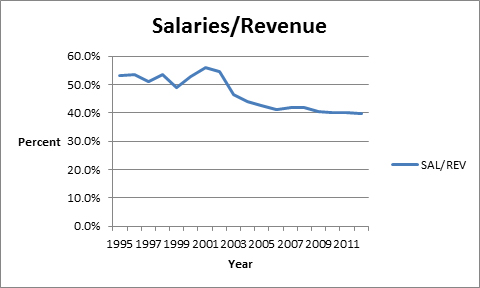
MLB Players' Salaries as a Share of Revenues: Laying Out the Issues

http://www.hardballtimes.com/wp-content/uploads/2014/03/TWO.jpg

The chart above clearly explains what the issue is.  Major League Baseball players' salaries have decreased relative to the league's revenues. The players' shares of the revenues used to hover above 50%, but have since fell to around 40%. As a point of reference, all of the other North American major professional sports leagues have collective bargaining agreements that guarantee players approximately 50% of revenue.

In terms of real dollars, the difference is more striking. MLB revenues were over $8 BB last year.  That means every  percentage point in 2013 represents about $80 MM in salaries. That's close to $100,000 per player.  And that's just for one percentage point of revenues.  If players were receiving the industry standard of 50% (a gain of ten percentage points), that would mean closer to a billion more dollars going towards salaries.

Some people may not think that this is a problem. Players salaries have still been increasing rapidly, even relative to inflation, when most peoples' wages have remained stagnant. Most of the world's workers are not losing much sleep over how athletes may be missing out on a few hundred thousand dollars.

Team shareholders and MLB officials also probably don't see what the problem is.  After all, this is extra cash going into their pockets.  It's a transfer of wealth from millionaires to billionaires, and most fans probably don't care.

But for players and their agents, this is a real problem.  In fact, this might be the biggest challenge the MLB Players Association has faced in a generation.  And while a significant number of players do earn generational wealth playing the game, many fringe major leaguer's never make that kind of money. For them, even a small change in salaries could make a real difference.

But the big question is "Why has the players' share of revenue decreased?" This is too big a question to answer in one post, but I think it is important to lay out the major issues that need to be addressed.  I have organized my thoughts into four major points, that will each be the subject of its own post.  Two are listed as "Player-side issues" meaning that they are most affected by the actions of players (or perhaps agents and the MLBPA as well).  The other two are listed as "Management-side Issues", since they revolve more around the behavior of teams and the league.

Remember, we are trying to explain hundreds of millions of dollars in lower salaries, so it's probably not just one thing. And if it is just one thing, it would have to be a pretty big thing. Before I get into the issues that I will be addressing, I'll mention a few other alternatives.

Some could claim that revenues and salaries are not being measured accurately, or consistently over time. If that were true, this may not be as big of an issue, but there's just no way that the we are off by such a wide margin to explain the relative decrease in salaries.

One other interesting possibility that I didn't list below is if the supply of baseball labor had changed in some significant way. More precisely, if there was less variation in talent, in say, the top 5000 baseball players in the world, then MLB players would have less leverage in negotiating salaries.  Since the quantity of players demanded has been static since the late 1990's, this could be answerable by looking at the data.  Until I see empirical evidence, I'm not giving this scenario serious consideration.

Matt Swartz's latest works on The Hardball Times were not the first pieces to call attention to the players' share of revenue, but they were the most helpful in getting started.  Cot's Baseball Contracts and Biz of Baseball are valuable resources for anyone looking to do research on the topics. Also, Tom Tango's (and his esteemed readers') comments were really what got me thinking about the issue.

So I've already used a bunch of words, and I haven't gotten to the main issues, so here they are. They'll be a post on each one, but for now I've just written enough to clarify what I mean.

Player-side Issues

1. Players are not optimizing their compensation. 

Basically, players and agents are losing many more contract negotiations than they are winning.  The main theory is that early career extensions have been lopsided in favor of teams.  More players are willing to bypass arbitration and prime years of free agency in favor of relatively less rich extensions. Some would argue that this phenomenon can even affect players who haven't received extensions. Jeff Passan of Yahoo Sports thinks this issue is very important, and wonders if less players are looking out for the "next guy". These extensions are certainly a far cry from players' fights against the reserve clause and collusion.

2. Salary is a relatively less important piece of player's compensation packages.

Another possibility is that players as a whole are placing less of a value on salary when signing contracts.  In this scenario, a relative decrease in salary isn't necessarily a problem for the MLBPA.  Players, like workers as a whole, may be increasingly factoring in location, career development, or "fit", when considering offers. In baseball terms, this could involve working with particular coaches,  being a part of a certain team chemistry, or even "playing for a winner". While this likely wouldn't explain a huge change in salaries, it could be a part of the trend.  We may also be missing out on the value of small items such as health care and the players' pension plan.


Management-side Issues

3. Teams have become more efficient in the way they compensate players.

A generation ago, teams were only effectively able to limit pay via collusion.  Today, there is a common framework that executives can use to put a value on every player.  Every team is at least aware of the market $/WAR.  Additionally, newly available statistics and more modern thinking may have led to cheaper, younger players occupying more roster spots relative to older, more expensive players. Regardless, the increase of business-minded management teams have led to more sophisticated roster construction.

4. The revenues of teams are now less dependent on team performance (and how much they spend on players).

Of all the issues, this has the most potential to impact salaries.  It would also be the most difficult problem for the players to address.  As gate revenue, and other revenue related to team success (merchandise, concessions, parking, etc.) have decreased as a share of total revenue, teams have less incentives to spend big on winning teams.  With most teams locked in on long-term local TV deals, short-term winning is also somewhat less important. National TV money, and other centrally distributed revenue (revenue sharing funds, MLBAM earnings), is earned regardless of team performance. Finally, the competitive balance tax acts as a disincentive for teams with the highest marginal revenue products from spending freely on players.

Additionally, across all sports, the business operations of teams have become more professionalized. Every team business official I've talked to has described the importance of separating financial success from on-field success.  With revenue targets that must be met regardless of winning or losing, perhaps a larger share of MLB's revenues should be going to the front office folks who are finding better ways to capture every last dollar (at least in the short term).

So those are what I consider to be the main factors.  I think that my individual posts will be more content-filled and incisive, but I needed this post to lay out the issues.  Hopefully it helped line things up for you as well, and let me know if I missed anything.

Labels: , , , , , , ,

Monday, November 4, 2013

Blogger Roundtable: The Yankees' $189MM Question


The New York Yankees enter unchartered territory for a team used to two things: winning and spending money.  The front office has stated its desire to reduce spending next season to below the Competitive Balance Tax (CBT) threshold of $189MM.  Doing so would not only alleviate the 50% tax on spending over the limit this season, but would reduce the rate to 17% in the next season they choose to spend big. 

But it will not be easy.  The team spent over $203MM last season and failed to make the playoffs for the second time in decades.  The team has some big holes to fill, along with a number of free agents who would demand big money to stay around.  And though internally the Yankees may wish to cut payroll, their fan base's expectations of October baseball are doubtful to change. Even GM Brian Cashman noted that $189MM "is a goal, not a mandate."

A possible attempt to slash CBT relevant spending appears to have failed in Derek Jeter's new $12MM contract.  It was thought that though it is an increase over the Captain's player option, that it would save on average annual value.  But though some complicated rules in the Collective Bargaining Agreement, the deal will cost the Yankees more in both real dollars as well as those which count for CBT purposes.

But there are reasons to be optimistic. With many expensive players coming off the books, the Bombers will have some room to work with.  If Alex Rodriguez misses all or most of next season due to suspension, upwards of $25MM could be saved.  Additionally, key target Masahiro Tanaka will be expensive, but his massive posting fee will not hurt the Yankees attempt to slide under $189MM.  It will take some creativity and maybe some restraint, but it's entirely possible the club makes its stated goal.

So here's the question for our esteemed panel:

Will the Yankees spend less than the $189MM competitive balance tax threshold in 2014?

Jesse Sherman (Director of Operations, SBS)- No

The 2013 Yankees payroll was well over $200MM- and I don't see it decreasing drastically below the threshold. The Yankees have three players making over $23MM for 2014 (Rodriguez, Teixeira, and Sabathia), and that's not including Robinson Cano who will command the highest salary on the team (unless the sides can agree to a back-loaded contract). The aged Jeter just received a pay increase, and the Yankees will have to bolster their pitching staff by spending some money this offseason. But with over 98MM already being committed to just 7 players, the only chance they have of getting below the threshold is by not resigning Cano or Granderson. But even removing Granderson's contract and finding a steady replacement won't do the trick.

Adam Kirsch (Co-president, SBS)- No

I don't think the Yankees will make it under the tax threshold next year.  A great deal depends on how they choose to address key free agents – most notably Robinson Cano's call for a monster contract. A few arbitration-eligible players, such as Brett Gardner and David Robertson, will also likely cut into the Yankees' thrifty efforts. After missing the playoffs this year, I think that Cashman and Co. will not be afraid to spend to keep their key pieces in the Bronx.  
 
Kevin Cole (Featured Blogger)- Yes
 
It seems like the Yankees are fairly determined to get under the $189MM number. The club's behavior over the last couple of seasons would be hard to explain should they abandon this attempt to get under the Competitive Balance Tax Threshold, and it does seem like they are poised to meet their goal of lowering payroll to this level. The Yanks have a lot of cash coming off of the books this offseason from the likes of Mariano Rivera, Andy Pettitte, Kevin Youkillis, and others. Salary write-ups that I've seen give the Yanks around $70 million to play with this off-season in filling about 18 big league roster spots.
 
The Yanks obviously plan on giving a large portion of that amount to Robinson Cano. But, they could have an extra $27MM to play with, should A-Rod's suspension be upheld. If that happens, A-Rod's spot will need to be filled for 2014, but the team will have some additional freedom in making some free agent signings. Some are speculating that the Yanks are poised for a nice spending spree this off season, possibly for the likes of Masahiro Tanaka, Brian McCann, Carlos Beltran, and others. We'll see about that, but I believe the team is set to meet the $189MM goal, resign Cano, and perhaps one or two other high profile free agents. Whether or not they field a playoff contender, though, remains to be scene.
 
John Zakour (Featured Blogger)- No
 
I don't believe the Yankees will spend less than $189MM, but I believe it will be close. The fact the Yankees are serious about Cano and Tanaka means they likely won't let a few mil stop them (who would?). There situation is fluid, and may even change depending on A-Rod's punishment. But the fact we're talking about this is noteworthy. It indicates a paradigm shift, and shows the Yankees might actually be (somewhat) responsible with their contracts. The title of the freest spenders in baseball rests safely with the Dodgers.
 
Matthew Hakimian (Featured Blogger)- No
 
Not a chance the Yankees have a payroll under $189 million heading into the 2014 season. Although the team was marred by an obscene amount of injuries throughout the course of the year, GM Brian Cashman will ultimately get his way. Not only does the team desperately need to resign Robinson Cano, but it also has no idea what the future of A-Rod holds. Look for the Bombers to be in the market for the likes of Brian McCann and Japanese product Masahiro Tanaka. Don't we all remember what took place after the Yanks missed the playoffs in '08?

Adam Malz (Featured Blogger)- No

While the Yankees front office has repeatedly stated that their objective is to reduce their payroll to $189 million, I believe they will end up going over that by the end of this offseason. The Yankees are set to embark on an offseason similar to that of 08-09 when they spent $423 million on CC Sabathia, Mark Teixeira, and A.J. Burnett. This year their targets include Robinson Cano, Carlos Beltran, Brain McCann, and Masahiro Tanaka. They will most likely end up spending over $300 million in contracts to the players that they ultimately sign. After this, it will be a huge financial challenge to get below the $189 million competitive balance tax threshold.
 

Labels: , , , , , , , , , , , ,

Monday, April 29, 2013

Does Union Solidarity Decrease Fighting in the NHL?

Rival stars such as Sidney Crosby and Alexander Ovechkin
flank NHLPA Executive Director Donald Fehr during the lockout.

Recently, in a collective bargaining course at the ILR School, a labor official familiar with this season’s National Hockey League lockout gave his take on a number of issues. While it was easy to accept most of his opinions on collective bargaining in sports as expert testimony, one prediction would have to be tested by looking at data. The speaker claimed that because of the solidarity developed among players during the work stoppage, the NHL would experience fewer fights this season. He felt that the goodwill exhibited as union brothers off the ice would carry over on the ice. 
The argument seems to stem from the fact that NHL Players Association Director Donald Fehr effectively united workers who are normally paid to compete against each other. The NHLPA leadership effectively pitted players against management rather than against each other. There was actually more dissent among League leadership and owners, who arguably compete for much higher stakes in normal years. But while solidarity is always an important part of union strategy in collective bargaining, could it have unintentionally made players less pugilistic?

Unsurprisingly, the stats do not overwhelmingly support this theory.  According to hockeyfights.com, there have been .50 fights per game since the lockout, up from .44 per game last year. Though the four year period of 2008-2012 shows an average of .54 fights per game, it decreased in each of those years, dropping a total .16 fights per game. It doesn’t appear that the lockout had any immediate effect in reducing fisticuffs between players.  


But this was an unusual season in many regards. The shorter season could make this data less reliable in theory, but more importantly it could have affected how often players drop the gloves. Perhaps, because of the intra-conference schedule (to make scheduling easier, Eastern and Western Conference teams did not play) the familiarity of opponents increased tensions. Or maybe more fights take place closer to the playoffs in normal seasons, and with the entire season taking place in this timeframe, a whole season’s worth of scores got settled in less time. A whole season of post-lockout data might look different.  

Fortunately (actually unfortunately), there is another data set, as the NHL did experience a work stoppage lasting the entire 2004-05 season. In the previous 2003-04 campaign, fights reached a violent .64 per game, with the four year period of 2000-04 seeing nearly .60 fights per game. But with a contentious year of collective bargaining behind them, players engaged in a historically-low fights per game mark of just .38 in 2005-06, and then .40 in 2006-07, before rising to the levels previously described.  


Following the missed 2004-2005 season and subsequent rule changes, fights rose after a dramatic drop off, then trended downward into the most recent lockout. 


Overall, it’s not clear what conclusions can be drawn from this theory. Maybe coaches were aware of a pacifying effect this time, and changed their direction to players accordingly. More likely, there are many variables involved with hockey fights, and the differences in the yearly data are explained by other factors. Still, any time NHL players from different teams are united together, there’s a possibility that it could have an effect when they are inevitably turned against each other. Looking at post-Olympic and post-All-Star Game data may help provide an answer.
One thing is for sure though. Fans that love to see the gloves dropped had little to be disappointed coming out of this lockout. Our guest speaker was stuck on quotes from players like Pittsburgh Penguin Tanner Glass, who said he was “firmly behind what we are doing” in expressing his NHLPA solidarity. Only a few months later Glass would be a little more hostile to union brothers like New York Ranger Aaron Asham, as evidenced below.


Labels: , , , , , , , , ,