Wednesday, November 13, 2013

Blogger Roundtable: Which League Will Grow the Most? (Part I)

h/t to Business Insider

The four major U.S. sports leagues in the United States generate massive amounts of revenue.  Although there is great disparity between the leagues, each has considerable potential for growth.  In today's post, we'll be asking some of SBS's E-board members which league's stock they would be buying.  Tomorrow, we'll look at what our featured bloggers have to say.  So here's the question:

Which of the four traditional major professional sports leagues (MLB, NBA, NFL, NHL) will experience the highest percentage growth in revenue over the next 20 years?

Gabe Cassillo (SBS VP of Magazine)- NBA

While there's not much certainty on any topic in the world nowadays, let alone sports, I believe it is a fairly educated guess to say that the NBA will experience the largest growth in revenue over the next 20 years. While Football may be the king of the day, the recent concussion concerns and long-term impact on quality of players lives cannot be overlooked. 20 years down the road puts us at the point in our lives when today's children will become the next crop of professional athletes. Basketball seems to have the international appeal and overall flashiness to keep up in today (and presumably tomorrow's) action-packed world of entertainment. I feel it is inevitable for the athletes that once would play football to slide over to the relatively safer and flashier sport in basketball.

Dan Cappetta (SBS Director of Finance)- NFL

I believe that increasingly advanced technology and a global economy will lead maximum growth to come through a league's expansion overseas in the next 20 years. To start, we can begin by narrowing the field through process of elimination. The NHL is probably the least likely to expand in my opinion--it currently generates the least revenue of the four major sports, and some star players are actually being pulled away from the NHL to play in leagues overseas that can offer absurd contracts, such as the Russian KHL (see Ilya Kovalchuk, Sergei Kotstitsyn). Growth potential looks bleak here. The NBA ranks above the NHL in revenue, but Commissioner Stern has said that he is uninterested in adding overseas teams. Stern's reign is coming to an end, so this may change, but without the willingness to expand, it won't happen.

The MLB ranks second in revenue, but the current structure of the game allows international markets to act as a sort of farm system for the league. Players in Central and South America, as well as Southeast Asia, namely Japan, funnel into the MLB promoting internal growth. Outside of these regions though, participation is minimal--there are only 2 European players in the league. The MLB's internal growth potential won't trump the possible expansion of the NFL, which is pushing its game on the rest of the world. As different cultures begin to understand and accept the game, and enjoy some of the aspects that Americans have come to love--the physicality, the once-a-week format, the live game experience, fantasy football, etc--growth potential is enormous. The league's talks to put a team in London is the first step. NFL will take the cake in this one.

Adam Kirsch (SBS Co-President)- MLB

I think we'll see Major League Baseball make major revenue gains.  The changing demographics of the United States, especially the projected growth of the Latino population, align closely with the high concentration of Latino players in the league and should benefit attendance and numbers and merchandise sales.  Furthermore, the league's edge in technology due to MLBAM's efforts will continue to keep the league ahead of the game (pun intended) in terms of online presence, a position I expect the league to continue to monetize successfully.

Labels: , , , , , , , , , ,

Thursday, September 26, 2013

Blogger Roundtable: NFL in London?


Will the NFL Have a London-based franchise by the end of the decade (2020)?  We gave our thoughts, so now it's your turn.  Answer our poll at the top of the blog and then leave a comment at the bottom of this post explaining why. 

In last week's edition of Blogger Roundtable, our newest Sports Business Society bloggers argued over who was the best commissioner in sports.  Two of the panelists chose Roger Goodell, citing among other factors, the National Football League's success in international markets (particularly London). 

Then on the September 17, SBS Skyped with alumnus Hussain Naqi, SVP of  Fan Engagement for the Jacksonville Jaguars.  Naqi has been charged with marketing and branding the team in the UK.  Naqi was able to provide a great deal of incite into the potential NFL market, although he dismissed the possibility of his Jaguars making a permanent move across the Atlantic.


And now the possibility of a London-based franchise has received more media attention than ever before.  ESPN has launched a series of articles on the issue, including Greg Garber's "More Than Just A Nice Place To Visit".  Here's what Garber had to say:

The good news for the skeptics? Players, coaches and staff of the four teams get to jump on a plane afterward and return home. But what if they didn't? What if there were a franchise in London? What financial, logistical and competitive challenges would have to be overcome?  
It's time to start asking these questions, folks, because it's going to happen. Yes, with some serious thrust from commissioner Roger Goodell and a league with a powerful hunger to increase its revenue streams, it's quite likely there soon will be an NFL team in London.
In a separate piece on ESPN, Kristi Dosh examines a variety of legal concerns that arise from a full-time London team.  Tax laws, working visas, as well as competition and free movement labor laws could get in the way of the desires of the NFL's business and marketing brass.

But could legal or other logistical challenges (such as travel) really get in the way of the most powerful sports league in the history of the world?  Or will Roger Goodell and the NFL break down any barriers that stand in the way of their expansionary goals?  That was the question we asked our bloggers and E-Board members this time around:

Will the NFL have a London-based franchise by the end of the decade (2020)?

Adam Malz (Featured Blogger)- Yes

 Yes, I believe that the by the end of the decade an NFL franchise will call London home. This is going to happen eventually, regardless of whether fans or players think it is right. Owners and the League are pushing for it because of the fact that it opens up a brand new and tremendously large area of revenue, as the domestic market is peaking. There are still a lot of obstacles and kinks that will need to be worked out, which is why I’m thinking towards the end of the decade. But I think it is certainly in our near future.

Gabe Cassillo (SBS VP of Magazine)- NO

While the NFL has the ambition and no doubt the resources to make a move to the UK happen (eventually) I think it highly unlikely such a move would take place by the end of this decade. Fans often cite fairly trivial "issues" that would impact such a move. Travel, time differences, culture, lack of fan base, etc. In reality, the time frame seems too aggressive. For a league experiencing continual growth, I question whether the 32 owners would be in favor of taking the risk by adding a team based in London. If I was a betting man, yes, I agree that one day the NFL will have teams overseas. Do I think that day will be by 2020? Not at all.

John Zakour (Featured Blogger)- Yes

In both articles, Garber and Dosh discuss a litany of problems that an NFL team in London would face. Tax codes, food, jet lag, logistical issues, would all have to be ironed out. But they're just minor issues. If Goodell wills a NFL team in London, it will be so. Roger Goodell won't let these triflings stop him from realizing his dream of a truly international, intercontinental NFL. It wouldn't surprise me if we have a foreign Super Bowl in the near future, which would precede a London team. Goodell wants this, against all reason, and he will find a way to make it happen.

Jon Levitan (Featured Blogger)- Yes

The NFL will eventually put a team in London. The league almost always gets what it wants, and clearly wants to have a team.  With two games being played there this year, the only question is when a team will eventually be placed across the pond. I would say that a team will be there by 2020, and I would also guess that that team will be the Jaguars. The market of Jacksonville just isn’t big enough to support a franchise that isn’t firmly entrenched there. That much is already clear, by the fact that the Jags will play a game in London for the next four years, which will be far more lucrative for them than their normal home games. By the end of those four years, the team may very well have a solid following overseas, and hopefully a better product to put on display. Although the league may want to place an expansion team London, as Garber’s article showed, I think the Jaguars will lobby heavily to be relocated.

Jesse Sherman (SBS Director of  Operations) - NO

Word on the street is that an NFL team in London is imminent. We've seen some successful trips to Wembley in the past few years. But that being said, I don't see a London-based franchise emerging before 2020. The current NFL CBA runs through 2020 and some labor laws between the US and London differ significantly enough to raise doubt in my mind. I don't think it will happen.. yet.

Matthew Hakimian (Featured Blogger)- Yes

One of Roger Goodell's main priorities since he came into power as the commissioner in 2006 has been to innovate the National Football League in all facets of the game, both on and off the field. We all know that he is one of the main proponents of an NFL team permanently relocating to London and it's looking more plausible each year. The most likely team to move to the UK would have to be the Jacksonville Jaguars as the team is scheduled to be featured in a game overseas through the 2016 season.  With one of the league's lowest fan bases, and faced with yearly difficulties with local television blackouts, it makes way too much sense to move the struggling Jags to London.

Will the NFL Have a London-based franchise by the end of the decade (2020)?  We gave our thoughts, so now it's your turn.  Answer our poll at the top of the blog and then leave a comment at the bottom of this post explaining why. 

Labels: , , , , , , , , , , , , , , ,

Friday, March 29, 2013

ILRSBS Goes to Phoenix: Part III

The team taking in the beautiful Phoenix skyline.
This is Part Two of a three-part series following the ILRSBS Case Competition team's trip to the SABR Analytics Conference in Phoenix, Arizona. (Click here to read Part One, and click here to read Part Two.)

When all was said and done, Hudson, Mike, and I were happy with our research and preparation. As we went to sleep at 3am, Phoenix time the night morning before presenting, we knew we had put all the effort possible into the case. Using an already overused sports analogy, we left it all out on the field.
Our team was scheduled to compete first that morning, at 9:30 sharp. In front of three judges from teams such as the Texas Rangers and Cleveland Indians, we were ready to make our pitch as part of a 20-minute presentation and 10-minute Q & A. Perhaps the most eye-opening part of the trip was just being able to stand in front of a room of extremely intelligent people and watch them as they listened to what we had to say. They truly did care, and the passion they have for the game was on full display. Often times we have these “epiphany” moments in our lives when we say, “How sweet was that?” I know I can speak for the three of us that one day, looking back; this certainly may be one of those moments.

Our team wound up finishing as the runner-ups in the Undergraduate division, as the eventual champions from NYU took first place. In the graduate/law division, Pepperdine University took top billing. For a three-man team, we were extremely proud of our accomplishment, and while we would’ve loved to win, the experience and learning we were able to participate in was recognition enough.

In addition to the Diamond Dollars Competition, the three of us were fortunate enough to interact up close and personal with some of the leading minds in the entire industry. Through various panels, and networking sessions, Hudson, Mike and I were able to meet top executives in Jed Hoyer, Rick Hahn, and Jerry DiPoto. Brian Kenny of MLB Network was one of the panel moderators, and throughout the conference we were able to connect and speak with various professionals from companies such as Fangraphs, Baseball America, Baseball Prospectus and other Major League clubs such as the Colorado Rockies, Texas Rangers, Cleveland Indians, and more.


Executives Daniels, Hoyer, and Hahn.
Perhaps the highlight of our week, however was getting to meet a fellow Cornellian that each of us one day hope to aspire to. Speaking with Rangers General Manager Jon Daniels was surreal. His advice was not only invaluable and thoughtful. Our two takeaways from him for were to watch as much baseball as possible, and to stay humble. As he put it, the game isn’t big on “self-promoters.”


The three of us with fellow Cornellian, Jon Daniels.
When all was said and done, the three of us had an amazing time. After a quick red-eye flight home, accompanied with a daylight-savings-time-change, we found ourselves back in reality of Cornell life.
As the inaugural Cornell case competition team members, a certain sense of pride exists in what we were able to accomplish. We look forward eagerly to next year when we send a few more students and continue to prove that the Ivy League knows its baseball.

Here are quick takes of our trips from my team members:
“It was a tremendous opportunity to be able to go to the SABR Conference and present our case in front of a group of highly regarded individuals within the baseball community. The conference itself was much more intimate and laid-back than others I had been to which allowed me the opportunity to speak with several Major League GMs, MLB Network Analyst Brian Kenny, members of the baseball analytics community, and a host of executives within Major League baseball. The only drawback to the conference, or more plainly the city of Phoenix in general, was the dearth of carne asada steak” –Mike Parnell
Outside the beautiful Chase Field in Phoenix.

Participating in the SABR Case Competition was a great experience. The opportunity to spend a few days working on such a fascinating case was awesome, and getting to present our work to MLB industry leaders was truly amazing. The conference brought together hundreds of forward-thinking baseball brains, and so many people brought great ideas to the discussion. Being a part of that conference was so much fun, and although we didn't win the competition, I can’t wait to go back next year.” –Hudson Belinsky 
Oh, and we also got to take in a few WBC games!
We hope you all enjoyed this look into our trip to Phoenix. We look forward to making this event a key part of the organization moving forward. For any questions, comments, or suggestions, please email me at gmc74@cornell.edu.

Labels: , , , , , , , ,

Thursday, March 28, 2013

ILRSBS Goes to Phoenix: Part II


This is Part Two of a three-part series following the ILRSBS Case Competition team's trip to the SABR Analytics Conference in Phoenix, Arizona. (Click here to read Part One.)

As mentioned previously, in projecting Mike Trout, we had an amazing talent on our hands. Looking at his WAR totals gave us a Hall of Fame type player, someone who would continue to produce at an MVP level into his early 30s. It became pretty clear to us that there would be no team with the resources available to trade for this type of player, so we turned our focus to figuring out what type of contract offer we could confidently extend to Trout.

$440,000,000 was the value of Trout’s production value to the Angels, yet, this number failed to account for risk. In any long-term agreement, each side takes on inherent risk. There are many circumstances in which the deal could turn out poorly. Injury, and lack of performance are the two main factors, yet in this case we also needed to account for the value of making life-changing money. Essentially it all boiled down to the guarantee of big money in the face of various risk factors.


After trying a couple different strategies, our team decided on generating a regression equation to determine a “discount rate” to Trout’s production value. We compared recent (since 2000) contract extensions, and examined the service time that each player had accumulated at the time of signing. After looking at the player’s production value ($4.5 million x WAR total = Expected Production) we plotted a regression against the service time at the time of extension. Our belief was that the more service time, or the more “established” a player was, the closer the player’s actual contract would be to his expected production value.

The extension data that helped us create our Regression.

Using the regression data we came up with the following equation: Discount Rate = -0.14511x + 2.000839. Plugging in the service time, we were able to establish a fair contract offer for Trout. Our offer to Trout would be eight years for $140 million, yet we would be willing to accept an offer up to $204 million over that time. With an agreement in this range, the Angels would lock-up an (projected) MVP-caliber player into his age 32 season. They would secure a face of the franchise, and they would not have to break the bank or mortgage their future success or payroll flexibility. From Trout’s perspective, he would get life-changing money, his first big contract that would now be guaranteed, even in the face of injury or lack of performance. 


Like the old game, Deal or No Deal, the more risk present, the more of a discount applied. By examining recent extension data, we confirmed our intuitive belief that this was the case. While players may be leaving some money on the table by taking extensions early on in their careers, they do so in order to receive security and peace of mind. In the end, the “Trout dilemma” boiled down to this issue of tradeoffs.

Angel's owner Arte Moreno will ultimately hold the
final decision on what to do with Mike Trout.
As a final piece to our presentation, we analyzed how the Angels could reasonably fit Trout’s contract into their current salary structure and obligations. By doing this, we also found that the distribution of money to Trout could vary year-to-year. In doing this, the Angels would maintain competitiveness (as a projected 90-win team) and still be able to retain their star at a fair price.

Check back tomorrow to hear how our team did and to hear about some of the other experiences from our weekend in Phoenix.


Labels: , , , , , , ,

Tuesday, March 26, 2013

ILRSBS Goes to Phoenix: Part I

Hello, Phoenix. Hello, SABR.

This is Part One of a three-part series following the ILRSBS Case Competition team's trip to the SABR Analytics Conference in Phoenix, Arizona.


Just two weeks ago, three members of ILRSBS were able to take part in a unique opportunity. The 2nd annual Diamond Dollars Case Competition in Phoenix, Arizona provided a platform for Mike Parnell, Hudson Belinsky, and myself to showcase just what Cornell and the Sports Business Society is all about.

Held as part of the SABR (Society for American Baseball Research) Analytics Conference, our case tasked us with developing, answering, and presenting our recommendations for a real-life baseball operations question. Last year, the case dealt with a “buy or sell” type question surrounding the Washington Nationals. This year, the focus was all on one of baseball’s most intriguing players: Mike Trout.

Yes, baseball’s most popular, mystifying and perhaps soon-to-be loved player was the focus of our entire case. You can imagine the excitement that came over our three-man team upon learning that we would be tasked with developing an appropriate contract extension for Mr. Trout. How fitting it was that days earlier, the real life Angels decided to renew the reigning AL MVPsuperstar at just $20,000 above the league minimum. As you can imagine, our first recommendation was simply, don’t do that!


Mike, Hudson, and Gabe working on the plane.


But in all seriousness, after receiving our case on Sunday morning, Mike, Hudson and I had four days to put together a cohesive 20-minute presentation on which to be judged. In the case, which was actually set following the 2013 season, Mike Trout went off for a 8.4 WAR season in which the Angels fell to the world champion Nationals in six games. In this scenario, the Angels would have one more season of Trout under cost-control as well as three years of control in which he would be arbitration eligible. Trout would become a free agent in 2017.


Placed in a position to advise Jerry Dipoto, the Angels GM, our team had to develop a contract proposal. Our three options were to trade Trout, to extend him over the short-term, or to provide him with a long-term extension. Playing into this decision would be our expected production of Trout, the value in dollars that he would be worth, the construction of the team around him, and the risk involved in such a contract. With the facts established, we set out to develop the best decision possible.

Through the next 4 days, we slogged through the massive amounts of data and processes needed to make our case to Mr. Dipoto. I’ll spare you the details, and just hit on two of the major highlights in our process.

The first is the manner in which we decided to project Mike Trout’s production for the next ten seasons (through age 32). As a team, we developed models for players similar to Trout in the three facets of the game, hitting, base running, and defense. Our samples were different for each of these categories, but they included players that met specific criteria for a player of Trout’s caliber and production. After developing an “aging curve” for a player such as Trout, we developed a Monte Carlo simulation to help predict the results for 10,000 seasons of Trout based on the previous three seasons’ production (weighted 45%, 30%, 25%). We continued the process until we wound up with ten seasons of Mike Trout production. What we got was one of the best players of all-time. To boil the numbers down a bit, Trout put up the following WAR (Wins Above Replacement) totals for the years 2014-2024: 8, 11, 11, 8, 11, 9, 9, 8, 8, 8, 7. Wow. Just. Wow.

Yes, Mike Trout, you are that good.


After we took Trout’s production value, we then assumed each win to be worth $4.5 million on the open market. Multiplying this number by his production we determined his value to be worth approximately $440,000,000 over the course of ten seasons.

Of course we couldn’t reasonably give Mike Trout $440,000,000, could we? Check back later this week to find out how we accounted for risk, what our final proposal was, what the judges thought, and how we spent the rest of our time in Phoenix!

Labels: , , , , , , ,

Tuesday, October 16, 2012

From the Booth #2: An Interview with Zach McCulley


This is the second post in a six post series featuring the Cornell At Bat broadcasting team. These posts will appear throughout the Fall semester. For part one of the series, click here

One hallmark of any successful baseball team is depth on the mound. Following a strong 2012 season where Cornell set a program record 31 victories and advanced to the NCAA Tournament for the second time ever, the hopes for repeating as Ivy League champions will largely rest on the team’s pitching staff. Adding to the already deep Big Red staff will be 6-foot-5 left handed transfer Zach McCulley.

The tall and lanky southpaw from Faulkner State Community College boasts a solid three pitch mix with an upper eighties fastball, a solid breaking ball, and a changeup. McCulley brings real experience to the team, and will be a welcome addition to the Big Red stockpile of arms.

Cornell At-Bat sat down with Zach to talk baseball, his journey to Cornell, and how through it all, his faith guides him. Read the interview after the jump.


Me: “Hey Zach, thanks for taking the time to speak with us today. How’s it going?”

Zach: “You got it, man. My pleasure.”

“Let’s get right into it, shall we? We’ll start you off with an easy one to get it started. Where are you from originally?”

Zach: I was born and raised in Pensacola, Florida, way down south. It’s much warmer there than up here, as I’m starting to learn, but it was really just a solid place to grow up.

It’s definitely a bit of culture shock, coming up north. Could you tell us a little bit about why you did choose to come to Cornell?

Zach: Well, being a transfer, this is the fifth school I’ve been at. William & Mary, Pensacola State, NW Florida State, and Faulkner State. Cornell was just the right fit for me and my family. It’s obviously a good mix of baseball and academics. After about a year and a half of reevaluating where I was going in life, I realized this was just the right place that God wants me.

Definitely. Can you take us through your personal path and how you traveled through all those different places?

Zach: Out of high school, I went to play baseball at William & Mary, but after a semester there I decided to transfer. Baseball wasn’t taken too seriously there and neither were academics and some of the other things outside of baseball. It was a real loose environment, and wasn’t really a fit for me. Spring semester of my freshman year, I was actually out of baseball and just went to school [at Pensacola] and that gave me a bit more time to reevaluate where I wanted to go with as far as baseball is concerned, and how I was going to let faith determine my path. Through the other two junior colleges, I was able to prepare to come here by getting the most innings possible under my belt.

How long did this whole process take, start to finish and eventually winding up here at Cornell?

Zach: It was about January of my freshman year until this past August when I committed here. It was a solid chunk of time spent just searching.

I think that speaks to your mental toughness, being able to go through that. Can you describe your season last year?

Zach: Junior College baseball is A LOT different from here. It’s a real blue collar environment in the respect that you’re doing field maintenance almost just as much as you’re doing actual work pitching or hitting. That really helps, though. We were more pals than teammates. It was really like an extension of high school baseball. We had a good run though as a team, and got to go down to Ozark, Alabama (the middle of nowhere) for our conference championships. It’s definitely a lot different from Ivy League athletics.

Did you work at any other positions?

Zach: (laughing) They didn’t want me to drop any bombs. It wouldn’t be fair for anyone.

(laughing) I see. Did you primarily start or come out of the bullpen?

Zach: My first appearance was actually out of the ‘pen and it was rather shaky. I came in with the bases loaded and preceded to cash ‘em in with a home run. That was definitely a humbling experience. They figured I wasn’t too good out of the ‘pen, so from there I started.

Ouch, that’s rough, but I suppose it worked out for the better. Off the field, what do you see yourself doing post-graduation?

Zach: To be honest, my answer to that question has probably changed a lot in the last year and a half. Initially I wanted to come here to make a lot of money (laughing). That’s what the word is. You go to an Ivy League school, you get a sweet job, and you’re set. But then I really started to understand the Gospel and what it means to have true faith in Jesus Christ. My goals have shifted and I’m not really sure where I’ll end up, but I’m hoping it’s a place where my faith can be exhibited through my job field and my entire life.

Do you see yourself staying in the game somewhere?

Zach: I can’t really imagine what it would be like to not have anything to do with baseball. I feel like the game will always have a place in what I’m doing, but honestly, I don’t know. I’d like to say so, but I just don’t.

What else are you involved with here on campus?

Zach: I’m involved with a few things here or there. I’m actually a member of FCA (Fellowship of Christian Athletes) and that’s a group that’s starting to grow and mature together. I’m also involved with another Christian Fellowship on Campus, CRU, and that’s really allowed me to meet a lot of great guys who share faith in Christ as well. It’s definitely important to get plugged into a community that you can grow together with. Other than that, I’m a semi-pro/amateur Ping-Pong phenom. A lot of time is spent their working on my game (laughs).

That’s awesome, definitely important to get connected. I’m going to give you a couple lighter questions here, rapid-style fire, ready?

Zach: Oh yeah.

Favorite team?

Zach: Braves. Or anyone that’s winning and/or has soft-tossing lefties.

When did you start playing?

Zach: When I was 3 and a half, got some pre-teeball action going on.

Were you always a lefty?

Zach: They actually tied my right arm behind my back. It was actually a little bit shorter than my left arm growing up. They took it seriously in my house (laughs).

Did your dad play baseball?

Zach: He did in high school, but he was a football guy and played at Navy. He broke all his knees, so he never had me play. I’ve always been baseball.

Starter or Reliever?

Zach: I had a good fall, was healthy. We have a lot of solid pitchers, and I think there’s 8 left-handers. There’s going to be a lot of competition, and I’d like to start. Hopefully within three-years that’ll happen.

Compared to fellow lefty,Cole Hamels for his
stature, McCulley hopes to perfect his craft like the Phillies' ace
 
Any other position you’d like to play?

Zach: Hmmm….

I know you’re a left and all of y’all like to tell me shortstop-

Zach: (laughs) I was leaning toward short, but I’ll go with catcher. I’d like to get dirty, throw my body in front of those balls in the dirt.

Very nice. If you could do dinner with three people, who would it be?

Zach: Oh man. Wow, well first off, it would have to be Jesus Christ. Christ died for me, and if I could speak to him at dinner, wow, I don’t think there could be a greater joy a man could have. Second, I’d have to go with the apostle Paul. The biggest thing that I’ve found in my faith is that I haven’t been bold enough when I could’ve been. Throughout the gospel you see that Paul is the boldest guy there is. Third, oh man, that’s a tough one. Let’s go with Stonewall Jackson. General Stonewall Jackson, one of the toughest men that ever lived.

(laughing) Stonewall Jackson? Wow, do you know why he’s called Stonewall?

Zach: I’d imagine it’s because he’s American, he fears nothing, and I heard he had rock-hard abs. Stonewall abs.

(chuckles) Excellent. How about pre-game, any routines/supersitions?

Zach: No superstitions but I like to get away from the guys a bit, collect my thoughts, talk to God and read a little scripture. I think last Spring, that was something that I picked up a lot. It puts into perspective what you do on the field and what you really stand for.

Is there any one verse that is your “go to” that you carry out with you onto the field?

Zach: Isaiah 40:31. It basically says that those who trust in the Lord will not grow weary, will renew their strength, and will soar on wings like eagles. Going on the mound, if you really believe that, all your anxiety just becomes so trivial. It’s like, “If I truly believe this, nothing is going to stand in my way.”

That’s awesome. Do you have any signature moments so far from your time with the team?

Zach: I’ll go with this Fall season. I had a good start, and after a few outings, I was probably floating a little too high. So naturally, I had a pretty humbling experience which has definitely turned into one of the best experiences so far. Chris Cruz hit a homerun. Belt-high fastball. It cleared the bases. I kind of sulked on that one for a few days, but that one really helped bring me down a bit. It reminded me to keep a level head and always to work hard. Welcome to the Ivy League, courtesy of Chris Cruz

You’re definitely not the first-

Zach: That’s what I’ve heard (laughing).

As we wrap up, what is your bottom line, number one reason for playing baseball here at Cornell?

Zach: I’m convinced that the reason I’m here is to use baseball as a pedestal for what I believe. I think if I wasn’t using this game to do that, to share my faith, than I’d be wasting my time. It’s obviously a privilege to be playing baseball at this level, but the bottom line, when it all comes down to it, I’m playing baseball to glorify God, and that’s not just to be cliché, but it’s what it comes down to.

And one final question, a real tough one. What’s one thing people don’t know about you?

Zach: I thought of this question earlier, and I’ve actually got a few. This first one needs to be taken seriously. I was 3rd grade spelling bee champion. There was a little discrepancy with how the word ‘which’ is spelled. Witch or which? I actually got a silver medal for that little performance, but the teacher never specified which spelling one was right. Not many people know that, but I WAS that 3rd grade spelling bee champion.

You just want to set the record straight?

Zach: Yeah, that needs to be out there (chuckles). Also, something else people need to know, and hopefully are getting to know is that I’m a Christian and I believe in my Lord and Savior Jesus Christ dying and rising from the dead for me. I think hopefully that becomes better known as time goes on. And I’ve got one more thing as well. You know Trent Richardson, right?

Of course.

Zach: Trent Richardson, who now is the running back for the Cleveland Browns, who went to ‘Bama and did work there is from Pensacola, my hometown. In the fall of 2009, he was playing against Tate High School, home of the Mighty Fighting Aggies. Trent goes up for a fast break dunk, and gets it thrown not two rows deep, but at least three or four. Just double-handed block, into the stands. Trent Richardson, world-class athlete, swatted.

Wait, you blocked him?

Zach: Oh did I. This thing was sent. I packaged it up, wrapped it and sent it on its way.

Did you let out any guttural sounds as you landed on the court?

Zach: Oh yeah, I let out a few screams, ripped my jersey a little bit, and I think I started waving my finger at him.


And he didn’t take exception to that?

Zach: (Laughing) Nah, well he’s obviously a lot stronger than I am, but I think after that swat, he got the picture, you know, who his daddy was. In other words, I am Trent Richardson’s daddy. That’s what people need to know about me.


And on that note, let’s call it a day. Thanks so much, Zach, for sharing with us. We wish you best of luck this season and hopefully a lot of opposing teams meet “their daddy” with you on the mound this Spring.

Zach: My pleasure.

For more information on Cornell At Bat or if you want to get involved, contact Alex Gimenez email at ajg322@cornell.eduFor previous Cornell At Bat adventures, look herehereherehere, and here.  

"Like" Cornell At Bat on Facebook

Labels: , , , , , , , , ,

Tuesday, March 27, 2012

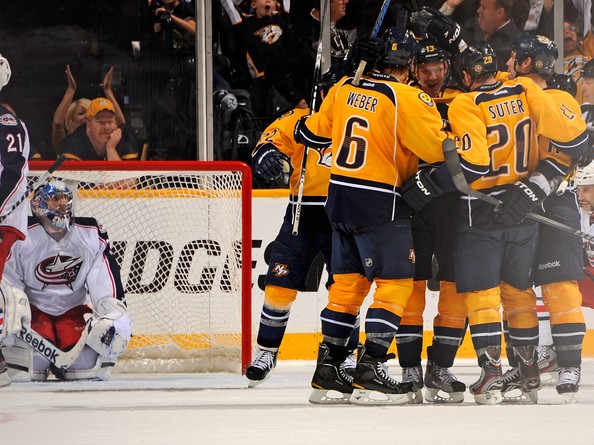
The NHL Standings Without the Loser's Point

Breaking: Even without the loser's point, Columbus still sucks. Nashville is still good.

As the NHL regular season draws to a close, the attention will soon shift to the radically different, exponentially more intense Stanley Cup Playoffs. Similar to the level of play, the game itself will actually change come playoff time, and yes, I am talking about the elimination of the shootout in favor of the much more grueling, adrenaline-pumping sudden death overtime, as well as the end of awarding one point for an overtime loss.

While I understand the concept of the shootout, and giving a consolation point for an OT loss, especially in a regular season 82 games long, it isn't truly indicative of whether or not a team is best suited for postseason competition. Parity is important, and especially for a league looking to generate as much buzz as possible, keeping as many teams close to a playoff berth down the stretch run is critical. Unfortunately, the reality is that awarding one point for an overtime loss - and by using the shootout to determine otherwise tied games - the NHL isn't fully valuing teams' ability to succeed in the playoffs.

A deeper look after the jump.

To see what I'm talking about, take a look at the standings, and the point totals as of 3/25/12. Then take a look at that number in parenthesis. This number is the point total of each team given 0 points for an overtime loss and with shootout wins removed from their record completely.

Standings as of 3/25/12

Place-Team-Points (Playoff Points)

East
1-NYR 101 (86)
2-BOS 89 (70)
3-FLA 87 (62)
4-PIT 100 (72)
5-PHI 96 (80)
6-NJ 90 (62)
7-OTT 86 (66)
8-WAS 84 (72)
9-BUF 84 (60)
10-WPG 78 (62)
11-TB 75 (62)

West
1-STL 103 (86)
2-VAN 99 (76)
3-DAL 87 (68)
4-NSH 96 (80)
5-DET 95 (76)
6-CHI 92 (74)
7-PHO 87 (62)
8-LA 86 (62)
9-SJ 86 (60)
10-COL 86 (62)
11-CAL 83 (62)

Some distinct changes definitely standout. For one, each team's total points are drastically reduced. Without the inflation of elements not included in the playoffs, we can truly see how skilled a team is at collecting wins (the only thing that matters come May and June) and doing so without the aid of what boils down to essentially a skills competition.

In relying solely on a playoff type system, true separation among teams is had. Instead of being separated by 17 points between 1st and 8th in both the East and West, the difference is increased to a 24 point margin.

In the end, this little exercise is far from a perfect way to gauge which teams truly are suited for the playoffs, but it does shed a little light on what we can look for going forward. Of course there are still more games to be played, (more for some teams than others), but as of now, this is a solid indication of playoff-built contenders.

As far as my picks to win the cup, I like the Rangers in the East, and the Predators in the West. I wouldn't be surprised, though, to see both Philadelphia and Chicago, both relatively underrated teams in terms of point inflation and seeding, make a run, either.

Labels: , , ,

Tuesday, February 21, 2012

Reflections on an Unexplainable Game

As pure and natural as kids on a sandlot

As the calendar moves to the latter stages of February, and the early days of March, the people's attention once again will turn to back to the Diamond. Yes, it’s that time of the year, where hope springs eternal, anything seems possible, and everything feels right with the world. Baseball is back.

For a game that very recently has been predicated on the technical through analysis of statistics, finding meaning in numbers, and identifying trends through various metrics, the reality is a simple one: sometimes there’s just no scientific explanation for the game we love.

Now don’t get me wrong, I, myself, am one of these individuals, searching for answers, predictions, and ways to advance the game. I love thorough knowledge. When you take a step back, though, like many other things in life, there may just be no scientific answer.

How do you quantify the crisp crack of the bat, as players practice in the warm sun, under the clear, blue sky? How do you analyze the camaraderie, the chatter brandied about by grown men? Can you really analyze what that new glove feels like when the ball meets it or that sweet “pop”?

What I'm trying to say is, there’s something magical about this game, something that deep down draws us all in. It’s that feeling of youthfulness, of seeing the green, fresh-cut grass, of listening to the sounds of the players, of seeing the white ball go from pitcher to bat to glove. It’s this thing that can’t be quantified, the human element of Baseball, and it's the thing that keeps us coming back, hungry for more, as a rite of passage every Spring.

While our society continues to speed up, and our game continues to become more methodologically-based, the unidentifiable variable will continue to exist. Players will be analyzed by the brightest minds who utilize the likes of all-encompassing statistics such as WAR, UZR, and PECOTA, but in the end, it's the game, a game for young men, that will remain. The human element, memories that our national pastime invoke, emotions that it conjures up, and feelings that it draws out of us, while un-quantifiable, is what will draw us all back again and again.

It's like an old friend calling up after a long, cold Winter, just to say, "Remember me?" You answer the phone, and pick up right where you both left off, nothing has changed. Welcome back, Baseball. We can't even begin to tell you how much we've missed you.

Labels: , , , ,