Friday, September 26, 2014

The Top 5 Most Critical Offseason Moves of the NHL


An in-depth look at the most crucial moves of the offseason, and how the players will impact their new teams.


1. Ryan Kesler, Center - Anaheim Ducks

Just before the 2014 NHL entry draft, two-time United States Olympian Ryan Kesler waived his no-trade clause and was shipped to the Anaheim Ducks in exchange for Nick Bonino, Luca Sbisa, and two picks in this past entry draft. The Ducks finished off last season with the most points in the Western Conference with a striking 54-20-8 record, and now with the addition of this new center, Anaheim will be even stronger. Kesler was one of the biggest trade targets during this past season after publicly stating that he wanted a fresh start, as he was not satisfied with the path of the Vancouver Canucks. In short, the Ducks were lucky to grab the 6-2 202 lb. center for such a good price. Kesler’s size, faceoff skills, and ability to score double-digit power-play goals will be key for the disappointing 22nd-ranked Anaheim power play this past season. The 2011 Selke trophy winner will anchor the 2nd line for Anaheim next to Swedish young-gun, Jakob Silfverberg. In 2011, Kesler proved he could guide a team to the Stanley Cup final by netting 41 goals and 32 assists for the Canucks. Kesler wants a championship and wants it now. His chances got a lot better after being dealt to the Western Conference juggernaut, Anaheim Ducks.

2. Ryan Miller, Goaltender - Vancouver Canucks

With the trade last year that sent of Cory Schneider to the New Jersey Devils, and the departure of Roberto Luongo in the trade that sent him back to Florida, the Canucks’ main objective over the offseason was to grab an experienced goaltender to lead them this season. The Canucks made the move to sign Miller to a 3-year, $18 million contract this offseason to fill this missing piece. Miller brings some needed experience to the Canucks goaltending. Miller spent his first 12 seasons with the Buffalo Sabres until this past February when he was traded to the St. Louis Blues. The two-time United States Olympian and 2010 Vezina trophy winner has shown that he is capable of stepping up and putting up note-worthy goaltending numbers; however, he will need to adapt quickly to the tactics of the offensive powerhouse California teams in the Pacific Division (Anaheim, San Jose, and the 2014 Stanley Cup Champions, Los Angeles Kings). If Miller clicks with the Canucks and performs under the pressures of the endless goaltending drama in Vancouver, we could see Vancouver make the playoffs unlike last year’s 12th place finish in the Western Conference.

3. James Neal, Right-Winger - Nashville Predators

In the midst of the first round of the 2014 NHL entry draft, the Pittsburgh Penguins made the first blockbuster trade of the draft sending power forward, James Neal to the Nashville Predators in exchange for Patric Hornqvist and Nick Spaling. The trade freed up some cap space for the Penguins, but they lost an important part of their offensive core. Neal finished last season with 27 goals and 61 points in 59 regular season games with the support of 2012 Art Ross and Hart Memorial trophy winner, Evgeni Malkin. Neal will be entering his third season of a 6-year, $30 million contract this season and will provide much needed offense to the Nashville Predators as the first line right-winger. In the 2011-2012 season Neal proved himself as a top-line contender scoring a career high 40 goals and 41 assists, a feat no Nashville Predator has ever achieved. We will also see Neal as the captain of Nashville’s power play this season, a role Neal took during the 2011-2012 season and scored a league-leading 18 PPG for the Penguins. The acquisition of James Neal will finally bring the presence of a big-time goal-scorer to the “Music City” that Nashville has always lacked.

4. Dan Boyle, Defenseman - New York Rangers

The most targeted defenseman in this past offseason was the long-time San Jose Shark, Dan Boyle. The offensive defenseman signed a two-year, $9 million contract with the New York Rangers. With the signing of Boyle, the reigning Eastern Conference champions filled a much-needed hole in their defense with the departure of Anton Stralman to the Tampa Bay Lightning. The 38-year-old has had a lot of experience in the NHL and his presence on the second line of defense for the Rangers will be crucial. Boyle will be playing a lot of minutes for the team especially as many see him having a leading role on the point during the Rangers’ power play. With Boyle’s offensive minded play comes his capability of driving possession of the puck, which will be key when trying to attack the opponent’s defensive zone. Adding Boyle’s gives the Rangers his proficient offensive tactics; however, it will be his defensive minded role that will be critical in trying to help the Rangers get back to the Stanley Cup Finals this season.

5. Mike Cammalleri, Left-Winger - New Jersey Devils

Mike Cammalleri, the 11-year NHL veteran left-winger, signed a 5-year, $25 million contract with the New Jersey Devils over the offseason. Cammalleri is coming off of an impressive season with the Calgary Flames scoring 45 points (26 goals and 19 assists) in his 63 games played. Although new to the team, the left-wing sniper will be playing on the first line with veteran and 2013-2014 Devils scoring leader, Jaromir Jagr, and assistant captain, Travis Zajac. Cammalleri’s presence on the top line will help improve the Devils’ subpar offense that finished 27th in the NHL averaging 2.40 goals per game. Did the Devils overpay for Cammalleri? Maybe. But, as Devils general manager Lou Lamoriello said before the offseason the Devils would be looking for the addition of scoring help on the market. Cammalleri has proved his scoring abilities by scoring 30+ regular season goals multiple times, so if he can catch fire the Devils will no doubt get back into the playoffs after missing them two years in a row.


Labels: , , , , ,

Wednesday, April 2, 2014

Is Big Free Agency Spending Worth It?


The Denver Broncos made some big moves in this year's free agency, picking up Pro Bowl linebacker Demarcus Ware and cornerback Aqib Talib.  After a terrible showing in the Super Bowl against the Seattle Seahawks in February, the Broncos organization is hoping that these moves significantly improve the team's defense.  Also, they had the most prolific scoring offense in history last season, led by quarterback Peyton Manning.  The big question is: will these signings lead to a Super Bowl victory in the near future?

Let's take a look back at the Philadelphia Eagles in 2011, who made similar big signings in the hope of winning a Super Bowl, with their prolific offense led by Michael Vick.  The Eagles actually made even more signings in 2011 compared to the Broncos in 2014.  The Eagles signed five big name defensive players to improve their team: Nnamdi Asomugha, Jason Babin, Anthony Hargrove, Derek Landri, and Cullen Jenkins. Asomugha was a high profile cornerback at the time, and was brought in to improve the pass defense.

The other four players were signed for their run stopping capabilities.  It seemed like the Eagles were going to have a great season - Vince Young even called them the "Dream Team."  But they didn't have the season that they were expected to.  In fact, in the 2011-12 NFL season, the Philadelphia Eagles had a 8-8 record and missed out on the playoffs, which was worse than the previous season, in which they made the playoffs.

Big free agency spending does not always lead to results.  The Denver Broncos, however, will not have a disappointing season in 2014-15.  Coming off of a Super Bowl defeat, they are hungry for more. The defense should be much improved this upcoming season, due to the free agent signings as well as Von Miller not being suspended.  And, to top it off, they have arguably the best quarterback of all time in Peyton Manning.  Seems like a recipe for success.

Labels: , , , ,

Friday, March 28, 2014

Blogger Roundtable: NFL Free Agency Analysis


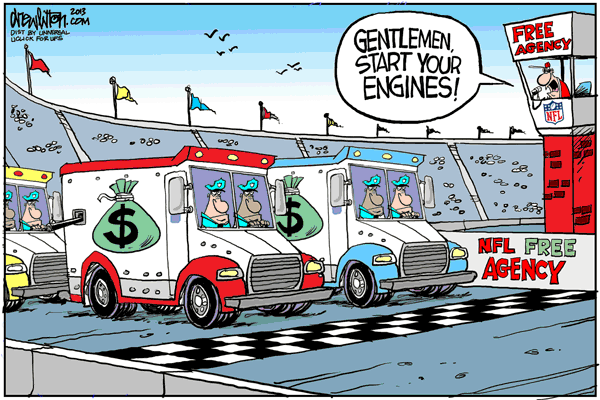
The wondrous period that is free agency has gotten underway in the NFL and the first two weeks have been exciting to say the least. Multiple big names around the league will be wearing a different uniform next year as they settle into their newest destination. We have seen the two Super Bowl contenders make some key signings that they hope will propel them to a return trip to the big game. Meanwhile, other teams are trying to make strategic signings in an attempt to fill holes before the draft on May 8th.

We asked our blogger's who they thought made the best free agent signing thus far. Here is what they had to say:

Matthew Hakimian, Featured Blogger- Darrelle Revis to the New England Patriots

As a Jets fan it hurts to say this but Darrelle Revis to the New England Patriots was a steal. Still one of the best cornerbacks in the league, Revis was cut last week by the new regime in Tampa Bay. After essentially trading Revis for NFL Defensive Rookie of the Year Sheldon Richardson, the Jets had the opportunity to sign the star corner, but Woody Johnson didn't want to deal with the drama. Bill Belichick saw a golden opportunity as the Pats scooped Revis up; I guess Revis has to apologize to his new head coach now though.

Stephen Dreznick, Featured Blogger- Denver Broncos

The best NFL free agency signings were done by the Denver Broncos. After having their defense embarrassed in the Super Bowl, they used their money to acquire Demarcus Ware and Aqib Talib. Even though people think that they overpaid for these players, they were able to improve their defense with Pro Bowl players. This, coupled with their high powered offense led by Peyton Manning, makes them serious contenders for a shot at the 2015 Super Bowl.

John Zakour, Featured Blogger- Jairus Byrd to the New Orleans Saints

The best signing of NFL free agency was the Saints and Jairus Byrd. The Saints supposedly couldn't free up any cap space, yet they reeled in the best free agent of the class and at an obvious position of need. People forget amidst their near record setting offense how pivotal elite safety play was to their Super Bowl year. The Saints are poised to put themselves in a great position to replicate their magical year.

Max Fogle, Editor-in-Chief- Every Team Who Doesn't Sign an Expensive Free Agent

While free agents definitely can be an important addition to playoff and championship teams, plenty of teams have success without breaking the bank for free agents.  This is probably due to the fact that good teams have a productive core of players already under contract taking up most of the cap space.  It's really not a bold statement to say that many good teams this season will not sign major free agents this spring.

Be sure to comment below to let us know your opinion.

Labels: , , , , , , , , ,

Monday, February 10, 2014

The Weekly Rant: Starting Pitching Market Trends


The offseason is finally winding down, with just a few significant free agents still out there. The highest upside players available are mostly starting pitchers.  While Kendrys Morales, Stephen Drew, and Nelson Cruz are still unemployed, the real impact players left are Ubaldo Jimenez, Ervin Santana, and AJ Burnett.

Some may have anticipated the sluggers waiting on the market, but the high quality starting pitching for hire is surprising.  Burnett has always been in control of his market, so the choosy 36-year-old looking for the perfect one-year deal isn't really an indicator of the market.  But youngish, goodish, durable guys like Jimenez and Santana should have signed their lucrative deals by now, right?

I mean these were pitchers who were close to the top on most people's free agent rankings.  Among the 18 domestic pitchers in MLBTR's Top 50 Free Agent rankings, Santana and Jimenez were ranked No. 1 and No. 5 respectively.  And with older hurlers Kuroda and Burnett ahead of him, the up-and-down Jimenez was actually in-line for the third largest contract among free agent pitchers.

There's a couple reasons why they are still out there.  The obvious reason is they haven't received a contract offer they like.  The big reason why they haven't gotten that kind of offer yet (or why they never will) is because of the Masahiro Tanaka sweepstakes.  Tanaka split the market for starting pitchers into two segments. You either signed before he got posted, or you signed after he did.  No major league deals with starters went through while the Tanaka drama was unfolding. Check out the flurry of activity and then the long gap:

Dec. 3:  Ricky Nolasco signs with the Twins.
Dec. 4:  Scott Kazmir signs with the A's.
Dec: 5:  Phil Hughes signs with the Twins.
Dec. 6:  Scott Feldman signs with the Astros.
Dec. 7:  Hiroki Kuroda signs with the Yankees.
Dec. 14: Bartolo Colon signs with the Mets.
Dec. 16: Posting System Agreement is reached.
Dec. 26: Masahiro Tanaka is posted.
Jan. 22:  Tanaka signs with the Yankees.
Jan. 26:  Matt Garza signs with Brewers.

Obviously teams weren't going to keeps signing players at the rate they did leading up to the winter meetings (or else everybody would have been signed in 45 minutes), but there's no denying it held everybody up. Besides the actual process surrounding Tanaka, the uncertainty of his availability (along with Burnett's more recent drama) also had an effect on the market.

Now I can't prove that the presence of Tanaka will actually reduce the money other starters receive (I think it will a little, especially for a guy like Santana, who the Yankees may have been in on.).  But it definitely pushed the market back about a month.

I decided to take a look at the contracts starting pitchers were projected to sign, compared to the contracts they actually did sign.  I used the previously mentioned Top 50 Free Agent list from MLBTR, and used the predictions from their various free agent profiles of starting pitchers.  I left off Tanaka, Suk-Min yoon, Jason Hammel, and Roy Halladay. These are predictions made by industry experts, and while they are not perfect, they are pretty good.

Rank Name       Projected         Actual
  Years   Total $    Years   Total $     Date
1     Santana 5 75
2     Garza 4 64 4 50 26-Jan
3     Kuroda 1 16 1 16 7-Dec
4     Burnett 1 12
5     Jimenez 3 39
6     Kazmir 2 16 2 22 4-Dec
7     Nolasco 3 36 4 49 3-Dec
8     Colon 1 10 2 20 14-Dec
9     Arroyo 2 24 2 23.5 10-Feb
  10   Feldman 2 17 3 30 6-Dec
11   Johnson 1 8 1 8 20-Nov
12   Hudson 1 9 2 23 18-Nov
13   Haren 1 10 1 10 25-Nov
14   Vargas 3 28.5 4 32 21-Nov
15   Hughes 1 8 3 24 5-Dec
16   Maholm 1 7 1 1.5 8-Feb

You can see there are some notable discrepancies.  There are also a few that are right on.  Remember, some of these deals have important non-guaranteed elements, such as vesting options (Garza or Haren) or incentives (Maholm). Draft pick compensation will also be important to consider when Jimenez and Santana sign.  But there is still a lot going on in this data.

I decided to look at the date the contracts were signed.  This graph has the difference between the total value of the actual contracts and the total value of the projected contracts for each player on the y axis, and the date each player signed on the x axis (It's recorded as "days after Nov. 1", so that January 1= 61 days.)


Overall, the predictions were low (the new TV contracts likely resulted in double digit salary inflation). But the graph really looks like two sets of data when organized like this.  It's pretty clear where the Tanaka sweepstakes took place.  But the difference between the early and late contracts is pretty striking.

At the beginning of the offseason players were getting the same or more in average annual value or years, or both, than they were expected to.  The three domestic starting pitchers to sign in 2014 have all gotten the same or less in all of those categories.  Now this might change a little. If Burnett is really testing the market, he will likely get more than $12 MM.  And, Jimenez should still be able to land north of $39 MM. 

But Santana will probably come in at way under $75 MM.  And you could add another data point in the early signers column if we included Tim Lincecum.  His 2-year, $35 MM contract certainly blew away expectations, and may have been what set the bar so high, at least early in the offseason.

Overall, it seems this year that if pitchers signed early in the offseason, they earned more than expected. For guys signing later in the offseason, (It's only three guys so far), things don't seem so good.  Looking at it from the team perspective, adding your rotation help early didn't generally result in any savings.  It has certainly been an interesting free agent period for starting pitching, and it's not over yet.

Labels: , , , , , ,

Wednesday, April 10, 2013

The Impact of the Long-Term Contract in Major League Baseball

Buster Posey didn't need free agency to land his big deal.
With the recent contract extensions awarded to Tigers’ ace Justin Verlander ($180M/7 yrs) and Giants’ MVP Buster Posey ($167M/9 yrs), it’s hard to ignore what has become a powerful trend in Major League Baseball. Teams are locking up their young talent as we rapidly approach what Grantland’s Jonah Keri calls “the death of free agency.” The list of homegrown stars that have recently signed long-term extensions with their clubs is vast, highlighted by names such as Joey Votto, Felix Hernandez, and Evan Longoria.

Changes to the recent CBA, coupled with a new TV contract for MLB, have fueled this trend on both the supply and demand sides of baseball’s labor market. New luxury tax incentives to reduce payroll, as well as a revamped free agent compensation system that raises the implicit costs of signing a player, have created new risks for players entering free agency Rather than test this tenuous market, players are wise to ink lucrative deals as soon as they become available. Further, small-market teams, anticipating their equal share in MLB’s forthcoming massive TV contract with FOX and Turner Sports, are more willing than ever to pay a hefty price to keep their young talent.

So the stage is set for an era of parity in baseball. It’s no coincidence that this upcoming season is so difficult to predict, as the times of buying one’s way to a championship is essentially over. Instead, teams will need to direct funds toward talent development within their systems if they wish to compete.

But will the effect on competitive balance truly be positive? The answer is yes, but a very qualified yes. See why after the jump.

In the short run, there is no doubt this trend will help improve on-field parity. Teams evidently no longer feel compelled to trade their stars prior to their entering free agency, and similarly, big market teams simply won’t be able to buy up talent on the free agent market. But in the long run, the answer is not so clear-cut. The ultimate irony of free agency is that it has incidentally served as a great equalizer between small and large market teams. And the pattern of securing young players early in their careers threatens the balancing function of free agency.

Because players are not eligible for free agency until they have amassed at least six years of service, players generally do not reach the open market until their late 20s. At this point, most them have reached or passed their primes, rendering long-term contracts to free agents generally unfavorable for teams, particularly at the tail end of a deal. When you think long-term free agent contract, it’s much easier to come up with a bad one (Alex Rodriguez, Vernon Wells, Alfonso Soriano) than a good one (I can’t think of any). Free agency, therefore, has offered an easy out for small-market teams. They can let their soon-to-be-aging-stars walk, while saving face to their fans by blaming the rich. Then, they can funnel the cash that they would have wasted years down the road toward retooling their farm systems. Now, however, small market teams will remain on the hook for their star players even once they have passed their primes. Undoubtedly, Buster Posey is an excellent player. But $18.5 million for a 35-year old catcher in 2022? Probably not ideal. The Giants, of course, are a relatively large-market team and can probably absorb that cost. If Posey can go on and consistently perform at the level he is clearly capable, and wins the Giants a few more World Series on the way, no one in San Francisco will complain. But consider the Joey Votto deal ($251.5m/12years), in which the small-market Reds will owe him $21 million in 2023, when he is 40 years old. Sounds like an impending disaster.

Small market teams are trying to beat the free agent system that has stolen their talent since its inception. But this process has largely been a blessing in disguise, and these teams are now killing the very game that has allowed them to compete in recent years.

Labels: , , , , , , , ,